Budget Oscilloscope Recommendation?

Steve Rieck

New Tinkerer
Mar 24, 2023
21
14
8
I want to see if the chips on my SE/30 reloaded board are functioning properly. I don't want to invest a lot at the moment. Just enough to know what might need to be replaced. Would something like this be adequate?

 
  • Like
Reactions: JDW

JDW

Administrator
Staff member
Founder
Sep 2, 2021
2,541
1,993
113
54
Japan
youtube.com
I'm one of those exceedingly (over-the-top?) meticulous people who spend a couple weeks reading every review and watching every YouTube video I can find on something before I buy it. Reading the technical documentation for a technical product is also a must. But I do that mostly when buying expensive things. The FNRSI product discussed in this thread sells for $31.44 after applying the 15% off coupon on Amazon. (Bear in mind that it used to be $18 according to a video I link below, which illustrates the rock-bottom category this product falls into.)

Note that OWON, HANTEK and FNIRSI are all entry-level, budget-friendly brands that don't necessary produce tools that please the discerning technician or electrical engineer. As such, they may or may not serve the needs of the user. This is why more research on the part of the buyer is necessary when purchasing expensive stuff, but again, the price of the item in this thread is super cheap. Nevertheless, I found a few reviews that may interest you...

This YouTube review indirectly gives the "pros" but gives no "cons" whatsoever:

There is some technical discussion on EEVBLOG, which is the go-to forum for deeper dives into electronics talk, as many EEs and serious electronics hobbyist are there:

But perhaps the best YouTube video review of that handheld scope though was done by Adrian here:

Adrian shows the tool's limitations by injecting a 1MHz signal into it, despite the tool being 200kHz rated. Adrian also shows alternative handheld scopes that cost less than $100, so those may be candidates for you too. But so long as you have low frequency testing requirements, that super cheap DSO152 may fit the bill.

Also note in Adrian's video that he uses some high quality measurement tools and has the same EEVBlog 121GW multimeter I use, and he also uses a DE5000 LCR meter which I also use. Excellent tools. But even those great tools require user understanding. If you watch his video further you'll see he finds a suspected bad axial cap on a C64 motherboard and uses his DE5000 (the best LCR handheld meter out there) and finds the axial cap doesn't look too bad, but when he swaps in a new cap, it cleans up the voltage. That illustrates why tools aren't magic. Tools sometimes don't help you get to the bottom of a problem. Is a given cap bad or not? Adrian felt the cap with his fingers and knew it too hot, then he swapped out the cap and that particular problem was resolved. So it's SMARTS + TOOLS that often lead you to a solution. SMARTS are acquired over time and almost always involve collaboration with experienced people in forums like this one.

BOTTOM LINE
Even though the current price on Amazon is higher than what Adrian paid ($18), the little meter is so cheap you should just buy it and test it. You know going in that it won't be the BEST tool for the job, but only by usage can you learn if it is GOOD ENOUGH. It might be good enough for you. Give it a try and let us know over time how it works for you!

FUTURE CHOICE?
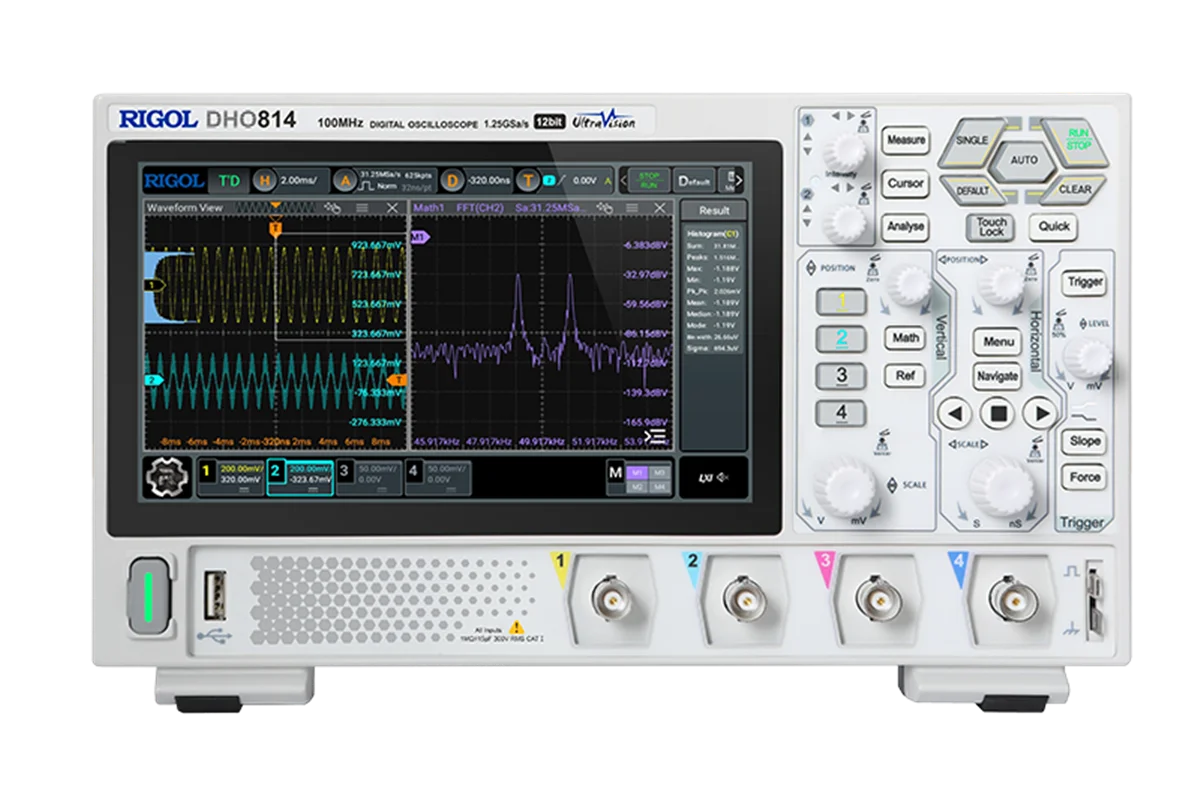
I currently use a Rigol DHO804 hacked (for free, by me) to get 100MHz bandwidth. I paid $358.66-shipped at the end of 2023, and I must say that this particular scope is fabulous for me as an EE in my hobby usage. I even bring it to the office at times to do measurements there because it sometimes beats our more expensive scopes. Dave from EEVBlog did a detailed review of it here:

I am not suggesting you buy the Rigol though because, higher price aside, I think it would be too complex for you as a first-time scope buyer. That's why I think you should just buy that cheap FNRSI to get started. When you learn more about how scopes work and also when run up against the FNRSI's limitations, you can then start thinking about more expensive and feature-rich scopes. But keep in mind that some scopes cost thousands of dollars. That's why I was so impressed by the Rigol DSO804 because it doesn't make a lot of compromises and matches the performance of scopes costing a lot more. I say this only because there are real gems out there for good prices. Cheap doesn't necessarily mean useless.

 
Last edited:

Paolo B

Tinkerer
Nov 27, 2021
303
182
43
Switzerland
I have poor experience with those miniaturized scopes: they work, but they are indeed tricky to use in practice. Besides, you may probably need at least 2 channels.
So, on my end, not being a pro either, I eventually spent totally reasonable money (in the range of 120 USD) on a used, but still fully operational 500 MHz, 4 channels scope from Yokogawa.
 
  • Like
Reactions: JDW and Steve Rieck

JDW

Administrator
Staff member
Founder
Sep 2, 2021
2,541
1,993
113
54
Japan
youtube.com
...fully operational 500 MHz, 4 channels scope from Yokogawa.

500MHz!


giphy.gif

:)

I've actually never used a 500MHz scope outside my engineering school days. Even the scopes at the office are all 100MHz, as is my hacked Rigol. (In the stock state, my Rigol was only 70MHz.) Quite nice you got such a great bandwidth scope and a fine price point.

I'm gonna go with the Zoyi ZT703S. Seems like significantly better quality and features for just a bit more money. Still very affordable.
You spotted that one in Adrian's video too, I see. It seems to be a nice little hand-held that would serve you well.
 

JDW

Administrator
Staff member
Founder
Sep 2, 2021
2,541
1,993
113
54
Japan
youtube.com
Wow. Very interesting looking device. At first glance I thought it was some kind of medical contraption. 😅

What does this button do?

1755945680948.png
 

Paolo B

Tinkerer
Nov 27, 2021
303
182
43
Switzerland
Wow. Very interesting looking device. At first glance I thought it was some kind of medical contraption. 😅

What does this button do?

View attachment 22972
It's for comparing waveforms vs predetermined ones. If the current waveform does not conform, a signal can be sent as output. It's basically for running quality checks on production lines.
 
  • Like
Reactions: JDW

iantm

Tinkerer
Sep 8, 2025
89
35
18
Michigan
iantm.com
Besides the enormous size and footprint is there any reason to reject a vintage oscilloscope? You ca find them sometimes on eBay for comparable prices.
 

Tony359

New Tinkerer
Jan 1, 2023
26
10
3
Swindon, UK
stumbled into this and thought I'd reply :)

Vintage (analogue) scopes are great but less great for digital diagnostics as you cannot "pause" the signal. On a data line all you're going to see is a big mess of lines. Still usable but for digital signals being able to pause the capture and magnify what's on screen is quite important.
Analogue scopes can be more helpful with other types of signals though.

That said, whenever I had to use my Fluke analogue scope I had to free up half of the workbench so I don't miss it :)
 

Trash80toG4

Active Tinkerer
Apr 1, 2022
1,155
337
83
Bermuda Triangle, NC USA
Radius 81/110 is the fastest thing I'd probably play around with. What's the minimum spec scope for spelunking a 110 MHz machine's board? Adrian makes me think these handhelds won't be useful on a 20MHz IIsi board? How about 33MHz?
 

JDW

Administrator
Staff member
Founder
Sep 2, 2021
2,541
1,993
113
54
Japan
youtube.com
The lower your scope’s "bandwidth" (e.g., 50MHz scope, 100MHz scope, etc.), the more your measured digital squarewaves will be shaped like sinewaves, and the smaller in amplitude the waveform will "appear" to be. The rule is to have a scope that's 5x (or even more) the bandwidth of your measured waveform. So when measuring a 100MHz squarewave with a 100MHz scope, you won't show a perfect squarewave. You'd really need a 500MHz scope to get really good measurement. With that said, you could still assess frequency with the 100MHz scope in that example. It's all a matter of how much "distortion" of your waveform shape and amplitude you are willing to accept. Lastly, if your scope is 500MHz, you need matching 500MHz rated probes. To use a 100MHz set of probes on a 500MHz scope when measuring a 100MHz signal would result in measured distortions due to the use of low bandwidth probes.

Why not buy a 500MHz scope then? Cost. Really, that's the only reason. And size. Most of the high frequency scopes are benchtop, not handheld. But again, it's all a matter of what you are measuring and what you deem "good enough."
 

Trash80toG4

Active Tinkerer
Apr 1, 2022
1,155
337
83
Bermuda Triangle, NC USA
That RIGOL DHO814 vid had me drooling, but I might need to spend a bit on one of these entry level units to get the hang of it?

My primary concern would be buying something "just good enough" to fix a Commodore 64 when the slowest system I'd be probing would be a 16MHz SE/30 and really want to be able to at least do troubleshooting on a 40MHz IIfx level of performance.

Doesn't sound like the cheap ones come anywhere near that, so what's the fastest system on which they're of any real; use at all?