
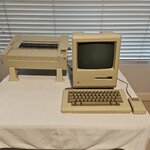
I have an original and complete Macintosh computer, including its packaging, software, and ephemera, which my mother purchased in 1984, and remains in the family today. It tells a rare story of early adoption and an unbroken chain of provenance to the present.
Provenance: After releasing the Macintosh in January, 1984, one of Apple’s first sales promotions was offered to students and staff at the schools in the Apple University Consortium. My mother was employed by the University of Michigan, a Consortium member. She purchased her Mac in May, 1984, along with an Imagewriter and MacWrite, MacPaint, and Microsoft Multiplan. In 1995, my parents shipped the computer, etc. to me for my young daughter to use. After another five years or so, she outgrew the Mac, so I packed it up and put it on the shelf for 25 years until just last month.
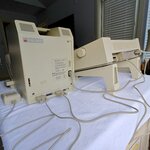
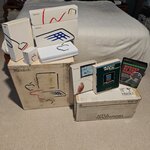
Hardware: This specific unit is Macintosh F4141L4M0001 – the 1840th computer assembled in Fremont during the 14th week of 1984 (April 1-7). All original Picasso-style boxes are included. The computer’s serial number matches to the packing box barcode label. In addition, serial numbers for the computer, keyboard, and mouse are written in red marker on the box, likely to assist Michigan’s Mac support staff with tracking inventory. They also branded the Mac by melting “um” into the rear case panel, further solidifying this computer’s provenance. All components including motherboard, RAM, 400k floppy drive, analog board, and power supply, are original. Nothing has been upgraded, and there is no sign of battery corrosion. The aftermarket fitted dust covers for the Mac and Imagewriter have aged with an inner plastic layer delaminating from the outside layer. Foam in the Imagewriter has also deteriorated.
Service and Repair: A month ago, following JDW’s excellent YouTube video, I cleaned and then lubricated the floppy drive with silicone grease. A couple of days later, while using the Mac to check software, all of a sudden - crackle, bang! - smoke rose out of the vents. C38, the RIFA capacitor, blew its top. (Fortunately, two days earlier I had taken a picture of the analog board showing the RIFA cap in place.) That cap and a transistor which was also damaged were replaced by a specialist in vintage electronics repair at the FixToGet shop near Seattle.
Software: System software is “System Update” with Finder 1.1g. Two versions of MacWrite/MacPaint are included: Original, with Version 1.0 of both products and Finder 1.0; and Updated, with MacWrite 2.2, MacPaint 1.3, and Finder 1.1g. Microsoft Multiplan is Version 1.02 and Finder 1.0. All software contains the manuals, disks, and assorted stickers, brochures, registration cards, etc. My mother left what came with each software product in its box.
I gave the “Murder by the Dozen” game to my mother as a 1984 Christmas present. I don’t think she ever played it. I can understand why. Waiting for I/O when I played the game reminded me of the DMV scene in Zootopia with the sloth clerk, who takes forever to process requests.
Additional pictures are at https://app.box.com/s/w9be3glixrrcffse62grvh4vlhw5jljg
Thanks for looking.
Ted
Provenance: After releasing the Macintosh in January, 1984, one of Apple’s first sales promotions was offered to students and staff at the schools in the Apple University Consortium. My mother was employed by the University of Michigan, a Consortium member. She purchased her Mac in May, 1984, along with an Imagewriter and MacWrite, MacPaint, and Microsoft Multiplan. In 1995, my parents shipped the computer, etc. to me for my young daughter to use. After another five years or so, she outgrew the Mac, so I packed it up and put it on the shelf for 25 years until just last month.
Hardware: This specific unit is Macintosh F4141L4M0001 – the 1840th computer assembled in Fremont during the 14th week of 1984 (April 1-7). All original Picasso-style boxes are included. The computer’s serial number matches to the packing box barcode label. In addition, serial numbers for the computer, keyboard, and mouse are written in red marker on the box, likely to assist Michigan’s Mac support staff with tracking inventory. They also branded the Mac by melting “um” into the rear case panel, further solidifying this computer’s provenance. All components including motherboard, RAM, 400k floppy drive, analog board, and power supply, are original. Nothing has been upgraded, and there is no sign of battery corrosion. The aftermarket fitted dust covers for the Mac and Imagewriter have aged with an inner plastic layer delaminating from the outside layer. Foam in the Imagewriter has also deteriorated.
Service and Repair: A month ago, following JDW’s excellent YouTube video, I cleaned and then lubricated the floppy drive with silicone grease. A couple of days later, while using the Mac to check software, all of a sudden - crackle, bang! - smoke rose out of the vents. C38, the RIFA capacitor, blew its top. (Fortunately, two days earlier I had taken a picture of the analog board showing the RIFA cap in place.) That cap and a transistor which was also damaged were replaced by a specialist in vintage electronics repair at the FixToGet shop near Seattle.
Software: System software is “System Update” with Finder 1.1g. Two versions of MacWrite/MacPaint are included: Original, with Version 1.0 of both products and Finder 1.0; and Updated, with MacWrite 2.2, MacPaint 1.3, and Finder 1.1g. Microsoft Multiplan is Version 1.02 and Finder 1.0. All software contains the manuals, disks, and assorted stickers, brochures, registration cards, etc. My mother left what came with each software product in its box.
I gave the “Murder by the Dozen” game to my mother as a 1984 Christmas present. I don’t think she ever played it. I can understand why. Waiting for I/O when I played the game reminded me of the DMV scene in Zootopia with the sloth clerk, who takes forever to process requests.
Additional pictures are at https://app.box.com/s/w9be3glixrrcffse62grvh4vlhw5jljg
Thanks for looking.
Ted
Attachments
Last edited:

