Striving to obey mankind's endlessly growing rules, laws and regulations is important to avoid trouble in life, but here lies the irony. Had there been no
illegitimate BLUE BOXES, Apple would never had existed and you and I wouldn't be talking about logos today as a result:
“Experiences like that taught us the power of ideas. The power of understanding that if you could build this box, you could control 100’s of billions of dollars around the world, that’s a powerful thing. If we wouldn’t have made blue boxes, there would have been no Apple."
—Steve Jobs
Am I trying to justify illegal actions? No. But I present that historical fact to pry open the rigid mind, especially the type of mind we've large come to have after being strongly influenced by the severe rule-based culture here in Japan, where I have lived continuously since 1994.
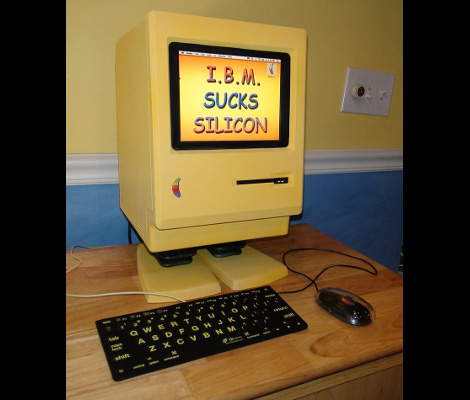
People in the vintage Mac community want an authentic looking replica, and if they are absolutely honest, they will tell you they want that regardless of whether the logos used are legitimately used or not. Saying that is not me encouraging the bad boys who use logos without permission. Nope. Not saying that. I am just giving you facts.
Nobody goes out and buys a cute Mac "clone/toy" and screams, "I love it BECAUSE of the TOTALLY AWESOME X-shaped rainbow logo on it!" Nobody. We tend to buy those things IN SPITE OF the inauthentic-but-legitimate logos, and sometimes we privately print or make our own authentic (and technically illegitimate) ones to make the toy look better.
And so...
Obey rules.
Try to live in peace with others.
But be honest and keep it real.

I understand what you mean, and I respect your perspective.
As a Mac fan, I also feel that if it were possible, it would be wonderful to build something using the real Apple logo. Anyone who grew up with the Macintosh probably feels the same way.
I’m actually working on a small project myself. It’s a Maclock that runs two operating systems: System 6 and KanjiTalk. I call it the NiziMac project. “Nizi” means “rainbow” in Japanese, so the logo is a simple

symbol.
In other words, I’m not trying to create something that pretends to be an Apple product. Rather, I want it to exist as a respectful homage to Macintosh culture while staying within legal boundaries.
However, in reality there are legal issues. If something might eventually become a product, using the Apple logo directly is not possible. The reason I chose to use a rainbow logo :
is first and foremost to avoid that problem.
So my project is not intended to be a perfect vintage Mac replica. Instead, I want it to be a device that lets people experience classic Mac culture — the floppy disk interaction, the startup sound, the desktop, the software, and the overall atmosphere.
If a user doesn’t like the
logo, they can simply apply an Apple logo themselves, just as many members of this forum already do.
In fact, early Maclock units used an interesting approach. The product itself shipped without a printed logo, and the package included both an Apple logo sticker and a square Maclock logo sticker so users could choose which one to apply. I think that was a very smart idea. Personally, I chose to apply the Apple logo rather than the square one.
However, including an Apple logo sticker probably meant that the underlying issue wasn’t completely resolved.
I’m Japanese, and I grew up in a culture where rules and intellectual property are taken seriously. For example, counterfeit iPhones are sometimes produced, and I believe that kind of direct copying is clearly wrong.
At the same time, I also think that homage or parody made with respect is very different from a deceptive copy.
Setting aside the Maclock logo issue, I think Maclock itself is actually a good example. Even though it isn’t an official Apple product, the attention to detail, the scale, and even the Happy Mac face show a real appreciation for the original Macintosh. That’s probably why many vintage Mac fans accept it and enjoy it.
My project is simply trying to follow that same spirit — not pretending to be Apple, but celebrating the culture that Macintosh created