Macintosh Portable & Powerbook 100 power adapter bench

  • Board Nominations
    Nominations have now closed and the results are available here.
  • Hey Guest, MARCHintosh 2026 is upon us. Check out community projects, join GlobalTalk, and have fun!

moldy

New Tinkerer
Aug 1, 2022
13
25
3
Online, you can find a lot of discussions related to what power brick to use with Macintosh Portable (the original is M5136 7.5V 1.5A), if it has to be exactly 1.5A or can be more and if it’s worth recapping the power supplies.

I decided to at least somehow help in those discussions with verifying two hypotheses on the bench:
  • Is it worth recapping?
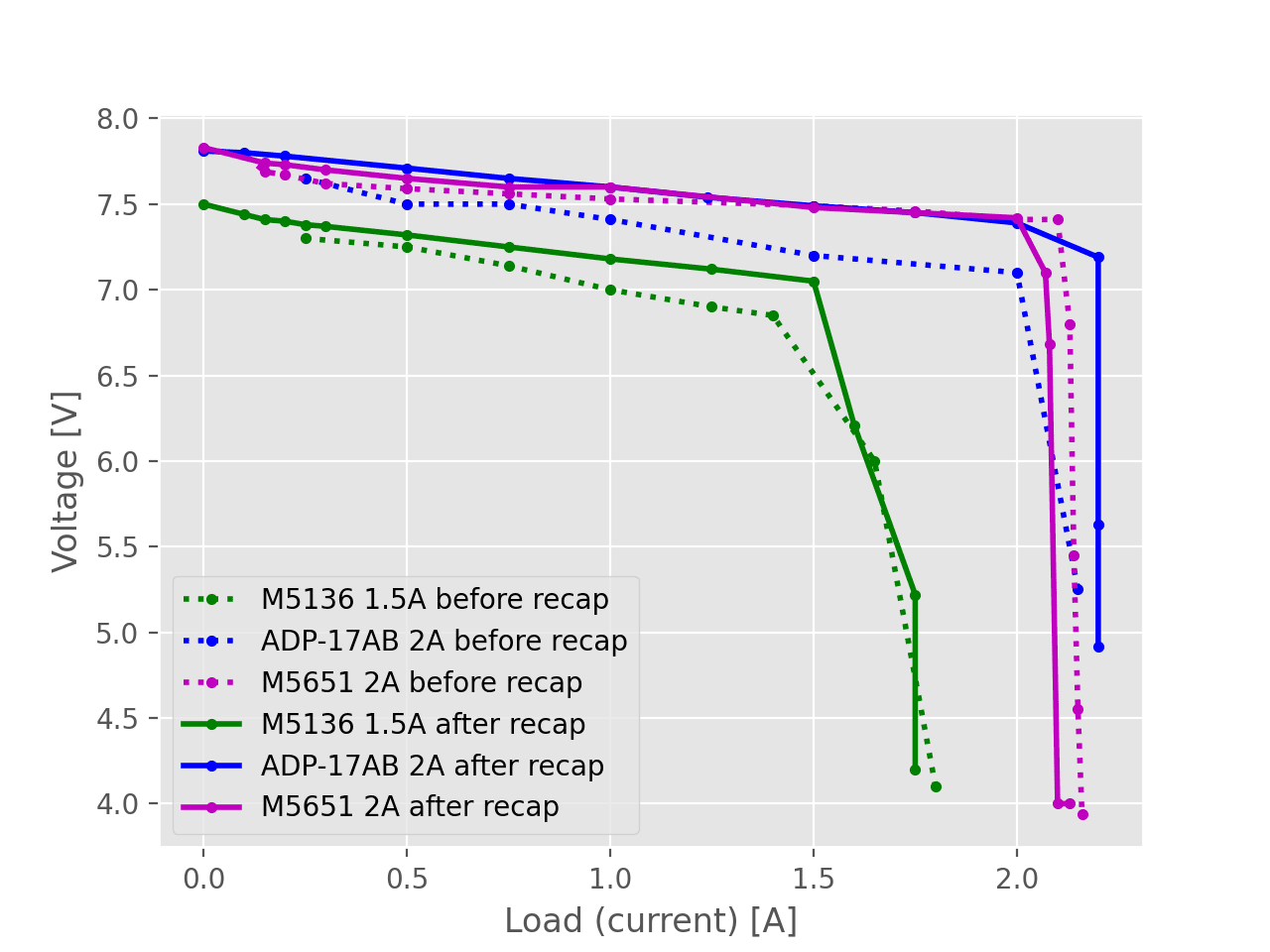
  • What is the voltage-current curve of the Portable power supply and to what extent does it differ from an Apple 2A power supply. This would permit others to potentially measure and select the power supply with the closest characteristics.
So I took 3 PSUs on my bench:
  • M5136 7.5V 1.5A (Macintosh Portable)
  • M5651 7.5V 2A (I usually saw it with PowerBook 100, it’s 15W nominal, but the Apple Technical Article claims it’s 19W?)
  • ADP-17AB 7.5V 2A (PowerBook 150)
By the way, here’s the archived Apple Technical Article about the PSU part numbers:
http://web.archive.org/web/20100423034550/http://support.apple.com/kb/TA32393

Is it worth recapping?​

Yes, definitely!
The old capacitors in those PSUs tend to lose rated capacitance and leak. The current curves in my case were slightly affected by the capacitors, I’m pretty sure that dynamic characteristics (eg. impulse response) would make it even more apparent.

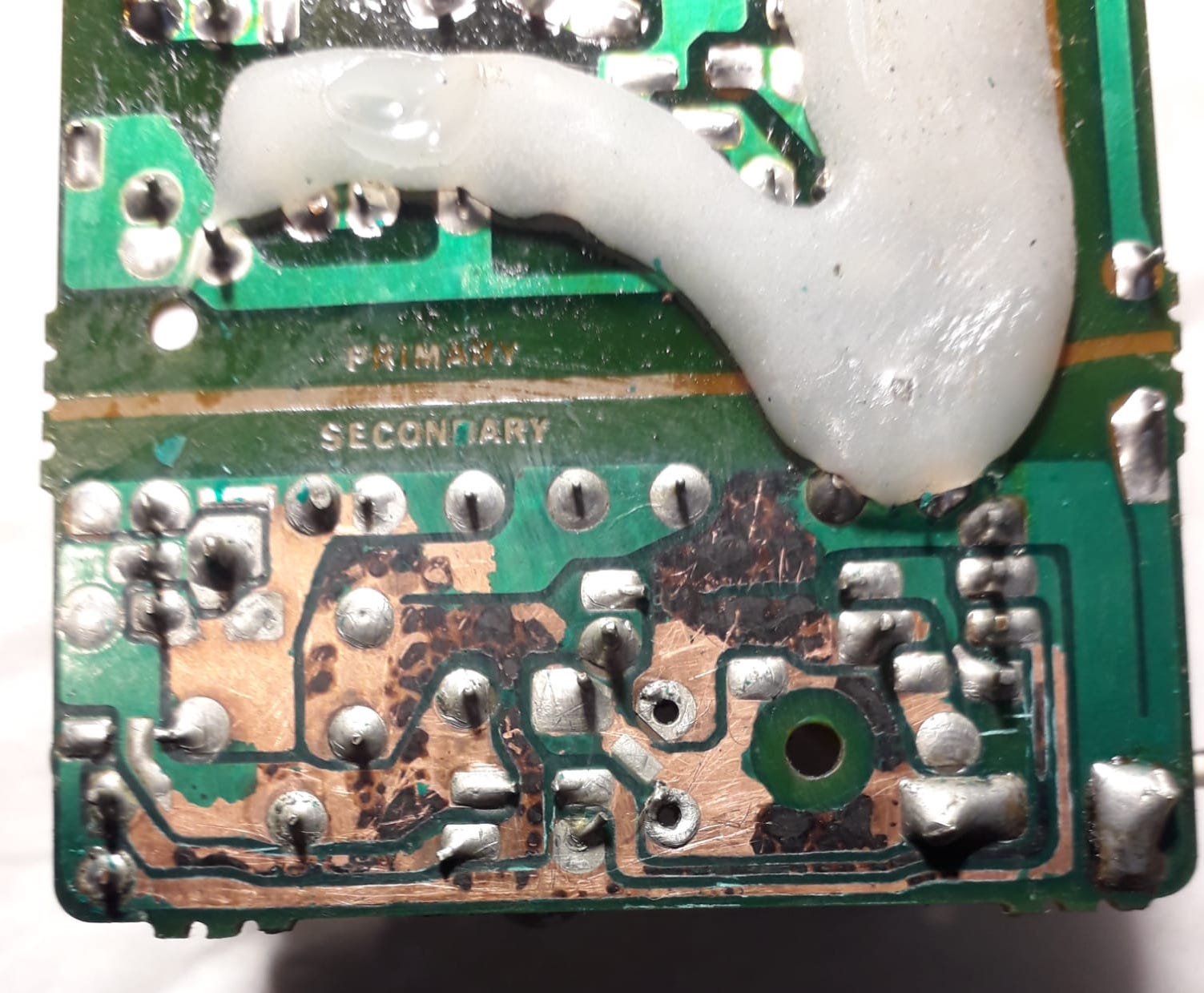
Leakage is another problem - the capacitor goo really eats out the soldermask and copper traces, making the PSUs simply non functional. Out of the three, ADP-17AB had pretty apparent traces of capacitor leakage:
WhatsApp Image 2022-07-26 at 09.52.21 copy.jpeg

The voltage-current curves or what is the difference between the adapters?​

I decided to spin an experiment and load the PSUs with various combinations of power resistor to record their voltage-current traces.

Here’s the result:
powerbook_adapters.png


Conclusions?
  • The output voltage of M5136 (Mac Portable) strongly drops at 1.5A, but even at 1.0A it’s only ~7.25V. It’s also clearly visible how the recap helped, before at 1.0A it was even lower at 7.0V!
  • M5651 and ADP-17AB behave pretty much the same and could be considered interchangeable.
  • Recapping of ADP-17AB made a big difference under load starting at 1.0A. At 1.5A, it brought about 400mV difference and 2.0A even slightly more.
 

JDW

Administrator
Staff member
Founder
Sep 2, 2021
2,683
2,107
113
55
Japan
youtube.com

daanvdl

New Tinkerer
Feb 8, 2023
7
9
3
Netherlands
Ah, I hadn’t seen this thread earlier, but it aligns perfectly with one of my recent projects.
I recreated the original Sony CR-76E power board used in the 7.5 V / 1.5 A M5136 adapters for the Macintosh Portable, intended as a replacement for boards that are beyond repair.

I’ve published the project as open source on GitHub:
https://github.com/daanvdl/macintosh-portable-cr76e-powerboard

Cheers,
Daan
 
  • Love
  • Like
Reactions: JustG and JDW

nottomhanks

Tinkerer
Oct 31, 2021
157
99
28
Hey @JDW , remember my 5126 backlight flickering issue, whenever there was disk activity or floppy activity, my backlight would start flickering. Upon closer inspection, I realized that the power supply I was using is only ranked at 1.0Amp, not 1.5Amp, as suggested. I wonder if the 1.0 Amp PS worked “for a while” but then over time the backlight board started malfunctioning. I had the whole machine (and display) rebuilt back in 2021. Would love to hear your thoughts. Also found this power supply on eBay: https://www.ebay.ca/itm/144844953007
 

JDW

Administrator
Staff member
Founder
Sep 2, 2021
2,683
2,107
113
55
Japan
youtube.com
I’ve been using the Portable Battery Eliminator with my Portable, which doesn’t care if the AC Adapter outputs 1.5A or even 10A because the adapter in my case plugs into the Battery Eliminator, for the express purpose of charging it’s super capacitors, which in turn allow the computer to boot.

People who don’t use a Battery Eliminator must plug their AC Adapter into the Portable’s DC power input instead, making the Amperage of Adapter used if critical importance.

I recently have been disposing of old electronic waste at our workplace by breaking up discarded devices. I broke apart a dozen AC Adapters that ranged from 26 years old to recent. They were either 5V or 12V output, ranging from 200mA to 1.0A output. Every single one of them used pretty much the exact same design. There was a transformer attached to a tiny PCB that had four diodes in a full-wave rectifier configuration and a single large smoothing capacitance capacitor on the diode output. That’s it. Capacitance ranged from 1000uF to 3300uF, rated at twice the voltage output. It’s poor man’s DC output.

in other words, these AC Adapters are not regulated.

If you’ve ever seen inside the stock Macintosh Portable’s AC adapter, the circuitry is far more complex because it regulates the output and offers various protections too. That’s why those stock Adapter are so physically large too.

In other words, the output of your typical AC adapter, which is not regulated, will vary its output and current in accordance with how stable or unstable your wall socket voltage is.

The scary part of all this is that we don’t know precisely how many milliamps is too much for the Portable or how much is too little. We’ve made guesses based on others experiences and know PowerBook adapters supply a bit too much current, which is why they seem to work for a while but end up frying the motherboard.

There’s obviously a “tolerance range“ that will not allow the Portable to work at all, or make it work perfectly fine, or provide too much current and eventually burn out circuitry on the motherboard.

A huge problem when buying an AC adapter is they almost never say if they’re regulated, in part because most of them are not, and they don’t state the tolerance range of their output when it comes to both voltage and current, as a result.

I clicked your link. When I was disposing of electronic waste, I did not break open one of those variable voltage output type transformers. However, the physical size of it tells me it’s most likely not regulated either. It would probably work well when your wall socket voltage is that its nominal range, but again I don’t know what the tolerance of wall socket voltage would be, and a non-regulated AC adapter will vary, depending on that input voltage.

All said, the only way to have true peace of mind and get to the bottom of strange voltage/current related problems is to feed the Macintosh Portable with a regulated power supply that gives precise output voltage and current values so you can eliminate voltage in current as being the root cause of any given problem. That leads us to the biggest question of all…

Where can we source a modern “regulated“ AC adapter which offers the exact voltage and current output needed to be plugged directly into a Macintosh Portable? (Something relatively compact and in a plastic case that features the correct plug shape and size.)
 

joevt

Tinkerer
Mar 5, 2023
269
107
43
I decided to spin an experiment and load the PSUs with various combinations of power resistor to record their voltage-current traces.

Here’s the result:
View attachment 13248

Conclusions?
  • The output voltage of M5136 (Mac Portable) strongly drops at 1.5A, but even at 1.0A it’s only ~7.25V. It’s also clearly visible how the recap helped, before at 1.0A it was even lower at 7.0V!
  • M5651 and ADP-17AB behave pretty much the same and could be considered interchangeable.
  • Recapping of ADP-17AB made a big difference under load starting at 1.0A. At 1.5A, it brought about 400mV difference and 2.0A even slightly more.
Your graph doesn't show the voltage reaching zero. How high of a current (lowering of resistance) did you try for each power supply? Would too high a current have voltage reach zero or would it damage the power supply?

Is there a way to make the 2.0A power supplies have a similar curve as the 1.5A power supplies? What if another resistor is placed in parallel to the load? What current/voltage would the load experience? What current/voltage would the power supply experience? Googling "how to make a 7.5V 2.0A power supply behave like a 7.5V 1.5A power supply" indicates that a method to do this would require more than a resistor.