Hey y’all,
a few weeks ago I posted about my Macintosh SE that suddenly died while it was running. I briefly left the room, and when I came back the machine was completely dead. The fan was not spinning and the entire room smelled very strongly of burnt electronics. I immediately unplugged the SE and have not powered it on again since.
Today I finally opened the machine to inspect the boards more closely, and I found some concerning things.
Logic board:
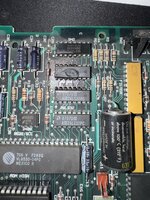
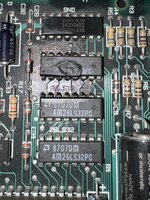
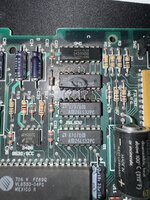
The logic board has a visibly burned IC, which I honestly have never seen before on a classic Mac:
That said, I’m aware that these machines are not hot plug capable and I did not connect or disconnect the BlueSCSI while the machine was running. The device was firmly seated in the connector and had been working normally prior to the failure.
Analog board
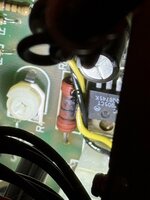
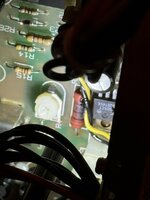
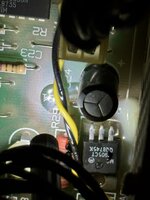
I also inspected the analog board (without fully removing it yet):
I also used a small AliExpress endoscope to inspect the inside of the PSU. I didn’t notice any obvious damage, although the inspection was limited by visibility and access.
Questions
Initially I suspected a PSU failure, but given the burned IC on the logic board and the suspicious area on the analog board, this now feels more like a systemic issue rather than a single isolated PSU failure.
Has anyone seen an AM26LS32PC fail catastrophically like this on a Macintosh SE?
The good news is that the AM26LS32PC is a generic and easily obtainable part, but I obviously want to understand the root cause before replacing anything.
Thanks so much in advance!
a few weeks ago I posted about my Macintosh SE that suddenly died while it was running. I briefly left the room, and when I came back the machine was completely dead. The fan was not spinning and the entire room smelled very strongly of burnt electronics. I immediately unplugged the SE and have not powered it on again since.
Today I finally opened the machine to inspect the boards more closely, and I found some concerning things.
Logic board:
The logic board has a visibly burned IC, which I honestly have never seen before on a classic Mac:
- It´s one of the three AM26LS32PC (quad differential line receiver)
- The package itself is clearly thermally damaged and partially melted
- The surrounding area also shows residue as if the whole chip burned for a few seconds
That said, I’m aware that these machines are not hot plug capable and I did not connect or disconnect the BlueSCSI while the machine was running. The device was firmly seated in the connector and had been working normally prior to the failure.
Analog board
I also inspected the analog board (without fully removing it yet):
- Near the PSU connector there is a power resistor with a dark / blackened area that looks like a burn mark.
- Directly above that resistor is a large electrolytic capacitor
- Next to it there is an area that looks like a glossy "puddle" on the PCB
I also used a small AliExpress endoscope to inspect the inside of the PSU. I didn’t notice any obvious damage, although the inspection was limited by visibility and access.
Questions
Initially I suspected a PSU failure, but given the burned IC on the logic board and the suspicious area on the analog board, this now feels more like a systemic issue rather than a single isolated PSU failure.
Has anyone seen an AM26LS32PC fail catastrophically like this on a Macintosh SE?
- Is it realistic that a PSU fault could have caused damage to components on both the analog board and the logic board?
- Alternatively, could leakage from the large capacitor on the analog board have caused downstream damage all the way to the logic board?
The good news is that the AM26LS32PC is a generic and easily obtainable part, but I obviously want to understand the root cause before replacing anything.
Thanks so much in advance!