

Some folks have been wondering about what I've been posting in another thread I've been using as a Development Notebook, so here goes:
Developing a carrier board to interface with the first gen Radius FPD/SE's four VRAM Chips. They'll be de-soldered and then inserted into wire wrap socketsinstalled in their place. Ask about details if interested. Right now I'm wondering if anyone can decipher the two approaches to Pi GPIO input I'm aiming to do:
First, I need to determine in what order the data lines need to be hooked up to GPIO so the 16bit word (register/whatever) makes sense. So attempting to use parallel inputs as a sort of logic analyzer setup to determine ordering of the sixteen lines:
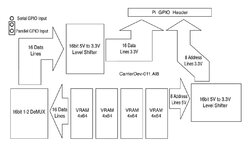
When I can figure out which lines need to be hooked up to which pins on the GPIO lines of the Pi Zero 2 W, I can then convert the sixteen parallel inputs to serial input on a single GPIO pin:
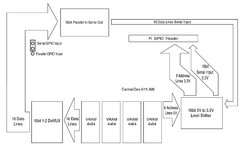
So the overall, inscrutable carrier board logic diagram looks like this . . . craziest pic for last:
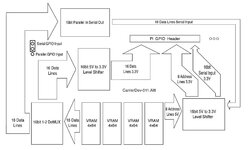
Assumption is that things like CAS, RAS and other signals on the VRAM will need to head into the Pi GPIO pins at some point? Serial input on a single line frees up 15 GPIO inputs for such fun and games!
Please comment on this:
- does the visual presentation make any kind of sense?
- If so, does my approach to the problem make any kind of sense?
- traditional schematic development will be notated one wire wrap connection at a time.
Aim at the moment is to get the same image output via HDMI as I get from the Card itself, comparing one screen to the other. After that image rotation will be simple enough, if slow with dropped frames on Pi. Project is aimed at implementation in FPGA and eventual cloning of the card therein. Titans of FPGA development have said "the project seems 100% viable."
So I'll need a lot of of help . . .
Developing a carrier board to interface with the first gen Radius FPD/SE's four VRAM Chips. They'll be de-soldered and then inserted into wire wrap socketsinstalled in their place. Ask about details if interested. Right now I'm wondering if anyone can decipher the two approaches to Pi GPIO input I'm aiming to do:
First, I need to determine in what order the data lines need to be hooked up to GPIO so the 16bit word (register/whatever) makes sense. So attempting to use parallel inputs as a sort of logic analyzer setup to determine ordering of the sixteen lines:
When I can figure out which lines need to be hooked up to which pins on the GPIO lines of the Pi Zero 2 W, I can then convert the sixteen parallel inputs to serial input on a single GPIO pin:
So the overall, inscrutable carrier board logic diagram looks like this . . . craziest pic for last:
Assumption is that things like CAS, RAS and other signals on the VRAM will need to head into the Pi GPIO pins at some point? Serial input on a single line frees up 15 GPIO inputs for such fun and games!
Please comment on this:
- does the visual presentation make any kind of sense?
- If so, does my approach to the problem make any kind of sense?
- traditional schematic development will be notated one wire wrap connection at a time.
Aim at the moment is to get the same image output via HDMI as I get from the Card itself, comparing one screen to the other. After that image rotation will be simple enough, if slow with dropped frames on Pi. Project is aimed at implementation in FPGA and eventual cloning of the card therein. Titans of FPGA development have said "the project seems 100% viable."
So I'll need a lot of of help . . .
Last edited: