JDW

Administrator
Staff member
Founder
Sep 2, 2021
2,480
1,938
113
54
Japan
youtube.com
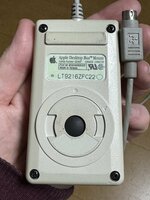
Apple Mice with the "low power circular symbol below" are not common to my collection, as I only have one...

1764729455965.png


And I have no idea why some ADB plugs on mice would need to be longer than the shorter ones. Shorter would seem to be better to keep it plugged in place.

But the big question is this. If there is no issue whatsoever with the LOW POWER mice, why didn't Apple make all of them low power at some point? Why waste power by selling high current-draw mice?

The only big issue that I've noticed among my mice is that some have heavier and larger balls. The smaller and lightweight ball mice don't roll as well.
 

Fizzbinn

Active Tinkerer
Nov 29, 2021
254
262
63
Charlottesville, VA
Apple Mice with the "low power circular symbol below" are not common to my collection, as I only have one...

View attachment 25053

And I have no idea why some ADB plugs on mice would need to be longer than the shorter ones. Shorter would seem to be better to keep it plugged in place.

But the big question is this. If there is no issue whatsoever with the LOW POWER mice, why didn't Apple make all of them low power at some point? Why waste power by selling high current-draw mice?

The only big issue that I've noticed among my mice is that some have heavier and larger balls. The smaller and lightweight ball mice don't roll as well.

From that Macintosh Portable and PowerBook: ADB Mouse Q & A 3/93 TIL article I took it to mean that the longer plug was to include a "ferrite EMI filter" that was somehow deemed required for low power, and or mobile use "to meet EMC standards". Not sure why those standards are different from the non-portable Macs using ADB mice though.

It does seem to make sense that lower power versions of the ADB mouse became possible using newer smaller process/die size components at some point, i.e. they weren't always possible. At some point they stopped making the original non-low power ADB mice.

1986 Original ADB mouse, "0.5 inch long connector"
~1989? Low Power ADB mouse, "low power circular symbol" and "0.5 inch long connector"
1989 Low Power/Portable (and PowerBook) ADB mouse, "low power circular symbol" and "1 inch long connector" (ferrite EMI filter)

I guess I'm wondering what happened to the "ferrite EMI filter" requirement for portable use? did regulations change? or perhaps all ADB mouse II units include one? (even though their connectors all appear to be 0.5 inch long...)
 
Last edited:

David Cook

Tinkerer
Jul 20, 2023
114
152
43
But the big question is this. If there is no issue whatsoever with the LOW POWER mice, why didn't Apple make all of them low power at some point? Why waste power by selling high current-draw mice?

I suspect they learned a lot about power usage when designing the portable. (The Apple IIc was always plugged in, correct?)

I'll guess that the order went:
1. Original mouse
2. Portable mouse
3. Hey we figured out how to make low power mice and will need some for our PowerBooks -- let's just make them all low power.

I have purchased a extension cable that I'm going to cut to be able to measure ADB current. I'll let you know what various mice draw.
 

JDW

Administrator
Staff member
Founder
Sep 2, 2021
2,480
1,938
113
54
Japan
youtube.com
The normal 80mA or so Apple ADB Mice will work on the Portable, but they post a greater battery drain, which is why the low-power model is recommended. But my low-power mouse is the one with the small and lightweight ball which isn't great at all to use. I wonder if they made low power versions of the mice with the larger and heavier balls.
 

David Cook

Tinkerer
Jul 20, 2023
114
152
43
I wonder if they made low power versions of the mice with the larger and heavier balls.

Yes. Apple ADB mice in my pile (not counting Apple Desktop Bus Mouse II or later)
(5) large heavy gray ball
(2) low-power large heavy gray ball
(1) low-power small middle-weight gray ball
(3) low-power small light-weight black ball

If you add in the Portable with a 1" inch connector, then there are at least five versions. The wikipedia article needs updating.
 
  • Like
Reactions: JDW

David Cook

Tinkerer
Jul 20, 2023
114
152
43
Oh, and at least two more variations exist:

non-low power small light-weight black ball (on the left side of the image below)

am90331-g5431-early.jpg


unusual ball retainer and skid (image below)

g5431-3-1.jpg
 
  • Like
Reactions: JDW

David Cook

Tinkerer
Jul 20, 2023
114
152
43
I just did a quick test.

The original ADB mouse uses 70 mA (64.8 idle).
The low-power ADB mouse uses 4.8 mA (4.65 idle).
The low-power small black ball ADB mouse uses 5 mA (1.75 idle).
The low-power small gray ball ADB mouse uses 4.8 mA (1.57 idle).

The Apple Desktop Mouse II are similar to all the low power mice of 4-5 mA (1.49 to 4.67 idle depending on model).

Indeed, the low-power mice really use significantly less power; less than 1/10th.
 
  • Love
  • Like
Reactions: Fizzbinn and JDW

JDW

Administrator
Staff member
Founder
Sep 2, 2021
2,480
1,938
113
54
Japan
youtube.com
@T-Man
Can you measure the ball diameter of your PB170's trackball?

@David Cook
Can you measure the ball diameter of your PB100's trackball?


I confirmed today that the Mac Portable uses a 33mm ball.

1764987823803.png


I ask because there's a lot of bad info out there. Even ChatGPT said the ball used in the Portable is 38mm. Flat out wrong.

My goal is to make my Portable & PowerBook Spreadsheet as accurate as possible.
 

3lectr1c

Active Tinkerer
May 15, 2022
667
334
63
the United States
www.macdat.net
Even ChatGPT said the ball used in the Portable is 38mm. Flat out wrong.
Please, please, please, please do not ever use ChatGPT for anything even semi-obscure. Everything in retrocomputing counts as "semi obscure", in my opinion. It will happily make garbage up where it doesn't have the info.

Unrelated note - it might be useful to know that the Portable and PowerBook 170 LCDs are a direct swap. Part numbers are slightly different but they are functionally identical.
 
  • Like
Reactions: Kai Robinson

3lectr1c

Active Tinkerer
May 15, 2022
667
334
63
the United States
www.macdat.net
A few notes and corrections as I look through the specsheet you linked:

- Active Matrix is not a "precursor to TFT" - TFT and Active Matrix mean the exact same thing.
- The keyswitch type used on all 100 Series PowerBooks is ALPS KFNR: https://telcontar.net/KBK/Alps/KFNR. I do not know if the PB100 specifically uses these switches or not, but all other 100 Series models (except the 150) do, along with the 500 series, 190, 5300, 3400, and G3 Kanga.
- I think all 100/140/170 PowerBooks shipped standard with Conner drives. I don't know exactly when Apple started shipping Quantum and IBM drives (though by the 180 they were shipping IBM), so I can't say this for 100% certain, but so far every single 100/140/170 I've seen has had a Conner drive in it.
 
  • Like
Reactions: JDW

JDW

Administrator
Staff member
Founder
Sep 2, 2021
2,480
1,938
113
54
Japan
youtube.com
Thank you so much for your input!

...the Portable and PowerBook 170 LCDs are a direct swap. Part numbers are slightly different but they are functionally identical.
I sometimes use ChatGPT as an errand runner because it can search multiple websites faster than I can, but I vet what it tells me. So my spreadsheet is by no means ChatGPT generated. I've spend many, many hours going through old books, newspapers and original source materials to compile what you see thus far. With some corrections made by kind people (including yourself now) in this thread.

So in like manner, I'd like to vet what you said about the LCD swap: Can we remove a PB170 LCD panel and physically mount it inside a Mac Portable 5126, then connect to the Portable's inverter and ribbon cable and it will work perfectly?

- Active Matrix is not a "precursor to TFT" - TFT and Active Matrix mean the exact same thing.
ChatGPT adamantly contends the Portable's Active Matrix display and TFT are two separate things. But my feeling is they are very much related, if not entirely the same as what we know as a modern TFT. You seem to be saying that even though no 1989-1991 documents use the acronym "TFT", the Portable display is exactly the same as a TFT of the same resolution? If so, can you provide a source document that basically proves that claim? It's not a matter me me not trusting you. And I certainly have no desire to offend you at all! I just make it a habit to vet info as best I can. My spreadsheet has a few unknowns which I couldn't vet, so if you can help me out with that, fantastic! (One unknown on the spreadsheet is whether the PB100 had an external battery charger kit, and if so, what was the Apple part number?)

Macworld Mac & PowerMac Secrets (5th Edition) lumps them in the the same category but separates them by using the word "and" as shown below.

1765012981313.png


I've already filmed part of my video about the Mac Portable, but I tried to be a bit ambiguous on the topic of "Active Matrix" and "TFT" by saying precisely this:

"...it was the world’s first computer to incorporate an active matrix LCD, which we call “TFT” today."

So people who hear me say that and believe "TFT" & "active matrix" are absolutely 100% the the same won't come after me, and people who separate them as "related but different tech at different points in time" won't be argumentative with me either. At least that's my hope.

- The keyswitch type used on all 100 Series PowerBooks is ALPS KFNR: https://telcontar.net/KBK/Alps/KFNR. I do not know if the PB100 specifically uses these switches or not, but all other 100 Series models (except the 150) do, along with the 500 series, 190, 5300, 3400, and G3 Kanga.
Thanks! I have updated my spreadsheet with "KFNR", but I put a "?" next to it under the PB100 because you are unsure about that model.

- I think all 100/140/170 PowerBooks shipped standard with Conner drives. I don't know exactly when Apple started shipping Quantum and IBM drives (though by the 180 they were shipping IBM), so I can't say this for 100% certain, but so far every single 100/140/170 I've seen has had a Conner drive in it.
Because I too could only "speculate" about the PowerBooks because they are machines I do not own, I deliberately left the word "Conner" out of my spreadsheet for the three PowerBooks. And because I own a Portable and know the history well, I used the word "Conner" for the drives under the 5120 and 5126 columns. So if anyone can definitely prove what manufacturer(s) produced the SCSI hard drives in the PB100/140/170, I can add that info into the spreadsheet.


Do you know the minimum OS for the PB100? Macworld Mac & PowerMac Secrets (2nd Edition) says it is 6.0.7, but it might be interesting if a PB100 owner could confirm it.

1765004524155.png


Here are the first 5 editions of Mac & PowerMac Secrets:


BTW, I absolutely love your PowerBook photo collection here:


Separately from that, if you've every swapped a CCFL tube on any of your machines, please feel free to chime in on my thread here, because I'm mulling the best way to remove the CCFL on my Portable 5126 in order to get a new one:


For everyone else reading this, I added a lot of updates to my spreadsheet today, including some cute icons, so feel free to check it out again. I will add it to the Resources section at the time I release my Mac Portable video, which I've been working on for the last two months. Most of that time has been spent in research rather than filming and editing. Man! I still have so much more work to do! And yet another reason it's taking so long is because there are so many darned problems! It's one thing after another. That's why I added my TinkerDifferent thread links to a new tab in my spreadsheet.

 
Last edited:

3lectr1c

Active Tinkerer
May 15, 2022
667
334
63
the United States
www.macdat.net
So in like manner, I'd like to vet what you said about the LCD swap: Can we remove a PB170 LCD panel and physically mount it inside a Mac Portable 5126, then connect to the Portable's inverter and ribbon cable and it will work perfectly?
I know for sure that the LCM is directly compatible. I'm not sure about the backlight. @techknight may be able to confirm.

With regard to LCDs - Active Matrix just means that each pixel's state is actively controlled, in contrast to passive matrix which is expected to remain in the last set state passively until it is refreshed again. A TFT LCD is an LCD in which every pixel has a corresponding thin film transistor which is used to actively maintain and control each pixel.
So, they are the same thing. Technically speaking, this component that controls each pixel doesn't have to be a transistor to be called an "active matrix display", but TFTs have been the only thing used since Active Matrix displays were first developed in the 70s and 80s, so saying they're two different things is definitely more incorrect than correct, and the Portable's LCD certainly uses thin film transistors regardless because every single commercial active matrix LCD does.

ChatGPT adamantly contends the Portable's Active Matrix display and TFT are two separate things.
And this is again why you shouldn't waste time using AI about obscure topics. It's a good thing you're verifying information, but that just wastes more time because you have to check everything it's saying anyways. I don't see the point... it would have been faster to just start by doing the research. Plus, when (and not if) it makes something up, then you're running down a wild goose chase trying to find where it got that information, which will waste even more of your time.
Imagine you go to the world's largest library and there's a guy named Joe who has encyclopedic knowledge of every single book there, and could tell you anything you wanted way faster than you could find it. But thing is, Joe loves to sprinkle in lies here and there. It is a well-known fact that Joe does this. Would you even bother talking to Joe, or would you just go try to find the book that has the information you look for?
BTW, I absolutely love your PowerBook photo collection here:
Thank you! I will have full photo galleries up soon for my 1400, 3400, PDQ, Pismo, and the iBook Clamshells as well :)
Any photos I've taken which are on my website are public domain as far as I'm concerned. Use them if you'd like to.
Separately from that, if you've every swapped a CCFL tube on any of your machines, please feel free to chime in on my thread here, because I'm mulling the best way to remove the CCFL on my Portable 5126 in order to get a new one:
I've done several tube swaps from other LCDs. Generally if the tube comes from another LCD of the same size, it has a good chance of fitting more or less correctly in place of the original. I believe you can also get modern replacements from aliexpress too. Not sure about the Portable specifically though. That LCD's tube is on the left side rather than the top of bottom like most LCDs so I don't know how it mounts or if you can get correct-sized replacements. Those were early days.
 
  • Like
Reactions: JDW

JDW

Administrator
Staff member
Founder
Sep 2, 2021
2,480
1,938
113
54
Japan
youtube.com
Any photos I've taken which are on my website are public domain as far as I'm concerned. Use them if you'd like to.
Oh, wow. You’re very kind. Thank you. And you do have some excellent photos there. It’s actually hard to find good photos like those, especially of a working machine. Most people who shoot photos that I’ve seen keep the screen off, perhaps because the machine is broken.

With regard to LCDs - Active Matrix just means that each pixel's state is actively controlled…
Yes, I am aware and agree with what you said. And in fact, TFT has been used, at least from what I have researched, since about 1962. But here’s the thing, and this is important… Not a single news source from back in the day when the Macintosh Portable was released ever used the acronym TFT or even “thin film.” They exclusively referred to it as active matrix. So did Apple.

That doesn’t mean anything you and I believe about TFT is wrong. It just presents something very curious. Why is it called TFT everywhere today, when it wasn’t back then, even though the term was concocted in 1962?

Hence, I’ve been a little bit careful about my choice of descriptions with regard to the displays used in the Macintosh portable. i’m trying to avoid a situation where nit-pickers come along and try to get into arguments with me because they watch my video. So that’s why I told you my previous post I recorded myself saying what I did. I think my word choice is correct and safe enough so I can avoid those arguments.
 

3lectr1c

Active Tinkerer
May 15, 2022
667
334
63
the United States
www.macdat.net
Active Matrix became "TFT" in marketing and specsheets over the course of the 90s into the early 2000s, as it became less important to differentiate between Active and Passive displays. "Active Matrix" and "Passive Matrix" sound better in marketing, are less technical, and are easier to remember than "TFT" and "DSTN".
It certainly doesn't help that a lot of marketing materials for LCD portables in the 80s especially would list having a "CCFT LCD" if they were backlit. This also went away as non-backlit displays ceased to be a thing. How similar the two sound may have have had an impact on marketers not wanting to say TFT.

The statement from your video is perfectly fine since you didn't imply they were two separate things. I do highly doubt you'll get any nit-pickers though.

In my website's laptop database, I use "active matrix" for stuff from the 90s and earlier, and "TFT" on stuff from the 2000s and up. Both because Active Matrix was the more common term in the 90s, and because it looks nicer in a specsheet where I'm listing all the display options for a laptop that shipped with both active and passive displays (which were mostly gone by the turn of the millennium).

Related, I list all passive matrix displays as simply "Passive Matrix" because laptop manufacturers often didn't list whether a passive LCD was STN, DSTN, FSTN, or whatever else. That, and they'd often get careless and list the wrong type of passive matrix display even when they did list a specific type. The only exception to this rule is with HPA displays, which I do specifically mention as being HPA.
 
  • Like
Reactions: JDW

3lectr1c

Active Tinkerer
May 15, 2022
667
334
63
the United States
www.macdat.net
Oh, wow. You’re very kind. Thank you. And you do have some excellent photos there. It’s actually hard to find good photos like those, especially of a working machine. Most people who shoot photos that I’ve seen keep the screen off, perhaps because the machine is broken.
It's no problem. The main reason I took those photos is to get high-quality shots of each machine online for people to reference and use. I've been meaning to add a note to the collection pages to tell people they're public domain.
 
  • Love
Reactions: JDW