
Apple Network Server MacOS based ROMs found
- Thread starter eric
- Start date
You are using an out of date browser. It may not display this or other websites correctly.
You should upgrade or use an alternative browser.
You should upgrade or use an alternative browser.

View attachment 28072
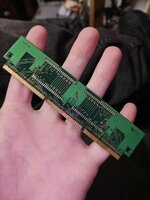
Pin 33 definitely appears to be tied to something in @mizerable 's photo. Must be power plane.
These may help? To me, looks like it's to the power plane, on the chips it's "v88"
Attachments
Last edited:

These may help? To me, looks like it's to the power plane, on the chips it's "v88"
Well, pin 33 on all four chips is definitely tied to a thicker trace and via as is typically used for ground or power plane connections. Visual doesn't tell us which one it is tied to, but given that the 29F800 on 7100 DIMM works, it must be tied to Power.
I wonder why? The ROM chips have a Byte# pin? The ROM chips use 33 as a another power pin? Apple left the option to put programmable chips on those modules?
Last edited:
Still installing Debian, pretty sure it crashed cuz I only have 196mb ram for now, switched to deb 8 and it recognized everything including network!
Here's the ANS running marathon on Mac OS, runs solid actually.
Are you doing that on the internal video, or a video card? What resolutions and colour depths are you getting?
Yeah, via the internal GPU.Are you doing that on the internal video, or a video card? What resolutions and colour depths are you getting?
I think 256 colors, at 480p not exactly sure. Ran p fine.
I have ordered a rage 128, should come soon, will let y'all know if it works.
Debian was able to see my ati GPU from my xserve, but didn't display anything, then again install still hasn't finished (slow. Needs more ram than 196mb)
The Rage 128 will work fine with the ANS. You may or may not have to change the output-device to it; I don't know how the 2.0 ROM works in that regard.

It likely would have been BYTE# on any ROM in that form factor, since they would be following the JEDEC standard.I wonder why? The ROM chips have a Byte# pin? The ROM chips use 33 as a another power pin? Apple left the option to put programmable chips on those modules?
Debian 8 on the ANS!
I do believe, unless anyone else has done this that I'm the first person to run a modern OS on this thing.
It's, slow...but imma push on regardless!
Last edited:

Awesome!!View attachment 28184
View attachment 28191
Debian 8 on the ANS!
I do believe, unless anyone else has done this that I'm the first person to run a modern OS on this thing.
It's, slow...but imma push on regardless!
... now run Doom on Debian on it > : )
I received @trag 's ROM SIMMs and tested them out thoroughly. One of the four appears to be a dud and I'll send that back to him for a post-mortem. The other three work. I was able to boot from the internal SCSI and internal video as advertised, and it even fixed my problem with the onboard MACE Ethernet.
However, I think some of the performance problems @mizerable is reporting is because this ROM doesn't seem to properly handle the L2 cache. (It also doesn't set parity on the RAM even if the RAM is parity, though the ROM also decides the timing, so it may not make much difference.) MacBench proves this out: the preproduction ROMs, which do handle the L2 and RAM correctly, get a CPU score that's seventy five percent faster. Even the disk rating is faster despite being limited to the external SCSI! Other aspects of this ROM, such as bogus devaliases, lead me to suspect this ROM wasn't actually finished.
Rhapsody does start on this ROM, but it doesn't get very far, presumably because of Bandit differences. But it gets farther than the preproduction ROMs do.
Bottom line is that if you want to run MacOS on the ANS, use the 1.1.20.1 ROMs and work around the glitches. Perhaps we can figure out a best of both worlds approach.
Here is a more detailed write-up, and again many thanks to @trag for doing this.

 oldvcr.blogspot.com
However, I think some of the performance problems @mizerable is reporting is because this ROM doesn't seem to properly handle the L2 cache. (It also doesn't set parity on the RAM even if the RAM is parity, though the ROM also decides the timing, so it may not make much difference.) MacBench proves this out: the preproduction ROMs, which do handle the L2 and RAM correctly, get a CPU score that's seventy five percent faster. Even the disk rating is faster despite being limited to the external SCSI! Other aspects of this ROM, such as bogus devaliases, lead me to suspect this ROM wasn't actually finished.
Rhapsody does start on this ROM, but it doesn't get very far, presumably because of Bandit differences. But it gets farther than the preproduction ROMs do.
Bottom line is that if you want to run MacOS on the ANS, use the 1.1.20.1 ROMs and work around the glitches. Perhaps we can figure out a best of both worlds approach.
Here is a more detailed write-up, and again many thanks to @trag for doing this.
Testing MacOS on the Apple Network Server 2.0 ROMs
It's time for another save point in the continuing saga of the various ROMs for the Apple Network Server , Apple's first through-and-through...
oldvcr.blogspot.com
Regarding making more ROMs:
1) Should I start a second thread to handle the logistics?
2) I suspect I should wait a little while so folks can digest @ClassicHasClass 's information. Some folks may want 2.0, others 1.1.20.1 or both and deciding may take a bit.
3) There will be no charge* for the ROMs. Anyone who feels a need to pay should make a donation to the operation of TinkerDifferent.
4)* I only have nine blank circuit boards left. Which leads to the caveat to #3. If folks (collectively) want more than 9 boards, then I'm going to prorate a charge across all the boards to pay for another small run of blank PCBs. A few years ago 20 blanks were about $60 so it's not likely to set anyone back much.
5) I am not testing these before sending them out. So you may get a dud, with the resultant frustration and shipping costs attendant with sending it back for replacement. In the past my success rate was about 19/20. This batch for classichasclass was 3/4 but I was also out of practice.
1) Should I start a second thread to handle the logistics?
2) I suspect I should wait a little while so folks can digest @ClassicHasClass 's information. Some folks may want 2.0, others 1.1.20.1 or both and deciding may take a bit.
3) There will be no charge* for the ROMs. Anyone who feels a need to pay should make a donation to the operation of TinkerDifferent.
4)* I only have nine blank circuit boards left. Which leads to the caveat to #3. If folks (collectively) want more than 9 boards, then I'm going to prorate a charge across all the boards to pay for another small run of blank PCBs. A few years ago 20 blanks were about $60 so it's not likely to set anyone back much.
5) I am not testing these before sending them out. So you may get a dud, with the resultant frustration and shipping costs attendant with sending it back for replacement. In the past my success rate was about 19/20. This batch for classichasclass was 3/4 but I was also out of practice.
To distill it a little for folks who aren't sure, the main point is whether you need hardware support or performance. The 1.1.20.1 ROMs do not support internal video, internal SCSI and (it turns out) internal MACE Ethernet, and you may have to reset the board or monkey with Open Firmware between reboots. (I describe those steps in the blog entries.) The 2.0 ROMs do not support the L2 cache, and they do not appear to boot AIX, but they also run Mac OS with fewer glitches and they support all the on-board hardware otherwise.
If you have a Mac video card, a compatible Ethernet card (I have the nearly unobtainium ANS Ethernet cards that work in Mac OS or AIX, but for Mac OS any compatible card will do) and an external SCSI device, and don't mind mucking around a bit, the preproduction ROMs are massively faster. You can also dual boot AIX or Mac OS with them, and AIX can still use the internal video and SCSI as usual.
If you just have an ANS and you just want it to work in Mac OS, you don't care about AIX, and you don't mind the speed penalty, the 2.0 ROMs are easier to work with in that circumstance. They are also the only ones that may ever have a prayer of booting Rhapsody.
But if you want to run AIX as intended, just run production ROMs. That's what's in my 500.
If you have a Mac video card, a compatible Ethernet card (I have the nearly unobtainium ANS Ethernet cards that work in Mac OS or AIX, but for Mac OS any compatible card will do) and an external SCSI device, and don't mind mucking around a bit, the preproduction ROMs are massively faster. You can also dual boot AIX or Mac OS with them, and AIX can still use the internal video and SCSI as usual.
If you just have an ANS and you just want it to work in Mac OS, you don't care about AIX, and you don't mind the speed penalty, the 2.0 ROMs are easier to work with in that circumstance. They are also the only ones that may ever have a prayer of booting Rhapsody.
But if you want to run AIX as intended, just run production ROMs. That's what's in my 500.
Can you do a
It looks like 1.x doesn't have
Only the 2.0 ROM looks at L2CR. The other 4 ROMs do not. So it's kind of strange that 2.0 has worse performance. Maybe it's changed by system software or the toolbox ROM.
2.0 does not have a
2.0 does have m2spr in ExceptionTable.
Use CPU Director app in Mac OS 9 to get the L2CR values for comparison.
Get a list of the running drivers in 1.x and 2.0. MacsBug? Or "Display Name Registry"? or my DumpNameRegistry?
Extract the missing drivers from the 2.0 ROM and create System Extensions to load them in the other ROMs.
Change the
l2cr@ on the 1.1.20.1 ROM and do l2cr! on the 2.0 ROM?It looks like 1.x doesn't have
l2cr@ or l2cr! words so you would have to define them.Only the 2.0 ROM looks at L2CR. The other 4 ROMs do not. So it's kind of strange that 2.0 has worse performance. Maybe it's changed by system software or the toolbox ROM.
2.0 does not have a
l2cr! in Open Firmware. 3.1.0f1 and later do.2.0 does have m2spr in ExceptionTable.
Use CPU Director app in Mac OS 9 to get the L2CR values for comparison.
Get a list of the running drivers in 1.x and 2.0. MacsBug? Or "Display Name Registry"? or my DumpNameRegistry?
Extract the missing drivers from the 2.0 ROM and create System Extensions to load them in the other ROMs.
Change the
OFpt and OFtc resources in the Startup Disk control panel so that they make sense for your ROM.I'll look at this when I'm back on that console (remote again). The drivers won't change the need for 1.1.20.1 to boot from the external SCSI port, though. My main mission is just to make Mac OS reboot reliably on 1.1.20.1, and that would be enough for me. The internal video isn't that great, so not having it doesn't turn out to be a big loss.
Right. To boot 1.1.20.1 from internal SCSI, you would need Open Firmware to load the Mac OS driver from disk or add the driver to a PCI card with a flash ROM - any card should work as long as the flash ROM is large enough. You can make a ROM that has nothing to do with the PCI controller you pair it with.I'll look at this when I'm back on that console (remote again). The drivers won't change the need for 1.1.20.1 to boot from the external SCSI port, though. My main mission is just to make Mac OS reboot reliably on 1.1.20.1, and that would be enough for me. The internal video isn't that great, so not having it doesn't turn out to be a big loss.
Can confim 2.0 rom slow as piss.I received @trag 's ROM SIMMs and tested them out thoroughly. One of the four appears to be a dud and I'll send that back to him for a post-mortem. The other three work. I was able to boot from the internal SCSI and internal video as advertised, and it even fixed my problem with the onboard MACE Ethernet.
However, I think some of the performance problems @mizerable is reporting is because this ROM doesn't seem to properly handle the L2 cache. (It also doesn't set parity on the RAM even if the RAM is parity, though the ROM also decides the timing, so it may not make much difference.) MacBench proves this out: the preproduction ROMs, which do handle the L2 and RAM correctly, get a CPU score that's seventy five percent faster. Even the disk rating is faster despite being limited to the external SCSI! Other aspects of this ROM, such as bogus devaliases, lead me to suspect this ROM wasn't actually finished.
Rhapsody does start on this ROM, but it doesn't get very far, presumably because of Bandit differences. But it gets farther than the preproduction ROMs do.
Bottom line is that if you want to run MacOS on the ANS, use the 1.1.20.1 ROMs and work around the glitches. Perhaps we can figure out a best of both worlds approach.
Here is a more detailed write-up, and again many thanks to @trag for doing this.
Testing MacOS on the Apple Network Server 2.0 ROMs
It's time for another save point in the continuing saga of the various ROMs for the Apple Network Server , Apple's first through-and-through...
That makes sense why i didnt noticed any difference between the 256k and 512k sim, as well as mac os reporting 2MB of l2 cache.
I ended up sending my OG 2.0 sim to Eric, imma make one with the prepro, as i have a rage 128 (works perfectly fine) and a network card.
Losing internal scsi is kinda an L tho. i was gonna use it for raid haha.
My main usecase fir this is running debian, the 2.0 rom CAN, imma see if the prepro one can, and ill report its faster.
Currentlt, even with the 200mhz cpu, and 512mb ram, and 128. its...so slow.
Install took 2 full literal days, booting into debian takes 10 full minutes, and logging in takes 2.
Once its up, loading a website off it is fine, but lord have mercy if you need to update.
Ill give it a test, see which is preferable. i have a feeling that for most people, 2.0 is fine.
I guess it depends if ya wanna grab a gpu, networking, want aix (lord why, even as a histroical piece im so anti aix lol) for me though, i need da speed.
I also wanted to just rebuild the rom card, with the we and reset already tied to vcc, so all ya have to do is solder on the chips, also so we stop "wasting" 7100 roms.
Ill give this a go this weekend.
Last edited:
Also something that got brought up in the 68k forums, is, can anyone of you incredibly talented peeps modify the 2.0 rom to properly address the cache? i cannot imagine this is out of scope for one of yall.
I do understand the main issue being desoldering and soldering the rom (if fixing the rom is even possible), and currently it seems as though only 3 of us have the stuff to program, or at least, the will to solder.
If thats the issue, i dont mind desoldering and resolder chips to test for peeps.
Im honestly just not particularly sure what is and isnt possible, the knowledge and just time in the hobby difference between me and yall is probably vast haha.
I do understand the main issue being desoldering and soldering the rom (if fixing the rom is even possible), and currently it seems as though only 3 of us have the stuff to program, or at least, the will to solder.
If thats the issue, i dont mind desoldering and resolder chips to test for peeps.
Im honestly just not particularly sure what is and isnt possible, the knowledge and just time in the hobby difference between me and yall is probably vast haha.
It's not understood right now why it doesn't properly handle the cache. Repeatedly flashing the ROMs to test guesses isn't anyone's idea of a good time. I don't think this can be easily solved until we get the ANS emulated, which I know some Smart People(tm) are looking at, but doesn't yet exist.
My main interest is to get 1.1.20.1 to be a better host for OS 9, and that will involve some minor modifications to the operating system - which I suspect was done to whatever version of MacOS Apple demonstrated on them back in the day. That's a more achieveable goal for me, at least for the moment.
My main interest is to get 1.1.20.1 to be a better host for OS 9, and that will involve some minor modifications to the operating system - which I suspect was done to whatever version of MacOS Apple demonstrated on them back in the day. That's a more achieveable goal for me, at least for the moment.