

For Everyone: Some information on the Macintosh XL
(short version )
In January of 1984 Apple decided to phase out the LISA hardware line.
To reduce losses, the remaining LISA inventory was rebranded as Macintosh XL
The mac 128k/512k/MacXL were now marketed together as the "SuperMicros" and "Apple 32 Family"
Apple Dealers were given a kit to install that took a Lisa 2 and gave it new ROM and a screen mod kit.
Once the current ROM and screen kit were installed, the Macintosh XL could no longer run the LISA operating system.
Apple developed MacWorks, which allowed the Macintosh XL to operate as a very enhanced Mac Plus.
In November of 1985, Apple released the XL Migration Kit, which allowed you to export Lisa OS documents to Mac formats.
3rd Parties continuted to support the Macintosh XL with Xlerators 16-18mhz, SCSI expantion boards, 800 floppies, PFG boards and more, all of which did not support the Lisa OS, just MacWorks.
There is, of course, much more to the story, but you can get that elsewhere.
Here is some NEW Macintosh XL software!
While SOME of this software should be able to run on classic Macs (OS 6-7) it has not been tested on Classic Mac Hardware.
Note:
Sherpa will run without a FujiNet device; it only requires a connection to an AppleTalk network.
Checkers will run standalone, but multiplayer requires a FujiNet device.
Solstice will run standalone.
FujiNet:
There are several ways to add FujiNet networking to your MacXL. Serial FujiNet. Upgrade your ESProfile firmware to allow it to co-function as a FujiNet, Serial cable to a modern PC, Linux or Mac and let the modern PC act as the FujiNet or use some other ESP32 hacks.
The Software:
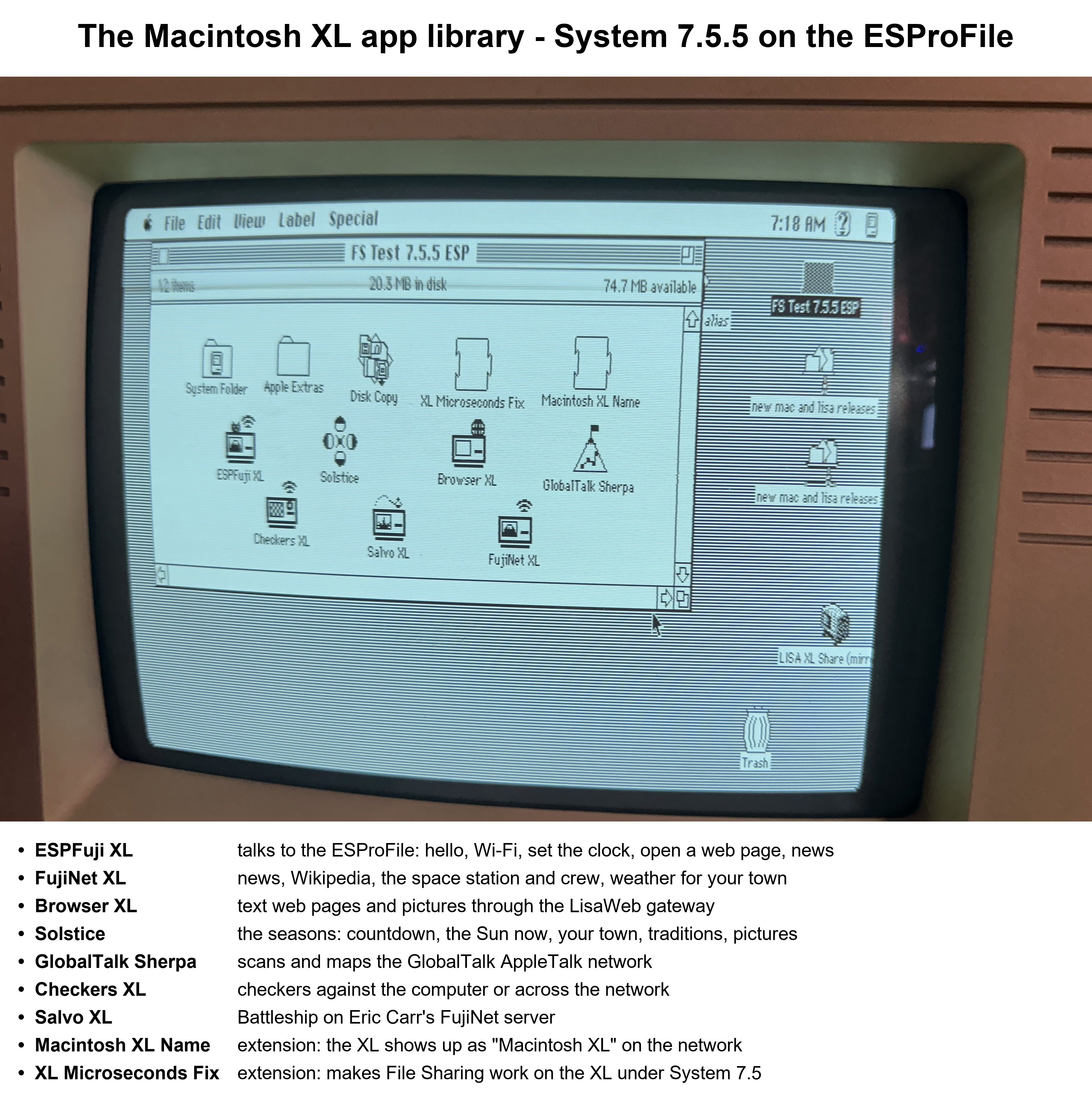
In a likely vein, to reduce confusion, I will post an overview graphic in this main post and then cover the other apps in replies.
Included are two Mac OS extensions specifically for Macintosh XL:
1. Microseconds Fix is an extension that fixes some network issues I ran into with MacWorks (see readme)
2. Macintosh XL Name. Allows a MacXL to show up in the "about" menu and on the Sherpa scans as a Macintosh XL rather than a Mac Plus.
(short version
)In January of 1984 Apple decided to phase out the LISA hardware line.
To reduce losses, the remaining LISA inventory was rebranded as Macintosh XL
The mac 128k/512k/MacXL were now marketed together as the "SuperMicros" and "Apple 32 Family"
Apple Dealers were given a kit to install that took a Lisa 2 and gave it new ROM and a screen mod kit.
Once the current ROM and screen kit were installed, the Macintosh XL could no longer run the LISA operating system.
Apple developed MacWorks, which allowed the Macintosh XL to operate as a very enhanced Mac Plus.
In November of 1985, Apple released the XL Migration Kit, which allowed you to export Lisa OS documents to Mac formats.
3rd Parties continuted to support the Macintosh XL with Xlerators 16-18mhz, SCSI expantion boards, 800 floppies, PFG boards and more, all of which did not support the Lisa OS, just MacWorks.
There is, of course, much more to the story, but you can get that elsewhere.
Here is some NEW Macintosh XL software!
While SOME of this software should be able to run on classic Macs (OS 6-7) it has not been tested on Classic Mac Hardware.
Note:
Sherpa will run without a FujiNet device; it only requires a connection to an AppleTalk network.
Checkers will run standalone, but multiplayer requires a FujiNet device.
Solstice will run standalone.
FujiNet:
There are several ways to add FujiNet networking to your MacXL. Serial FujiNet. Upgrade your ESProfile firmware to allow it to co-function as a FujiNet, Serial cable to a modern PC, Linux or Mac and let the modern PC act as the FujiNet or use some other ESP32 hacks.
The Software:
In a likely vein, to reduce confusion, I will post an overview graphic in this main post and then cover the other apps in replies.
Included are two Mac OS extensions specifically for Macintosh XL:
1. Microseconds Fix is an extension that fixes some network issues I ran into with MacWorks (see readme)
2. Macintosh XL Name. Allows a MacXL to show up in the "about" menu and on the Sherpa scans as a Macintosh XL rather than a Mac Plus.