SuperMac VidCards - Timeline Development - Links

Trash80toG4

Active Tinkerer
Apr 1, 2022
1,155
340
83
Bermuda Triangle, NC USA
Thanks! That's plenty good enough for my Rogue's Gallery. Gotta go through the new pics and enter the data on the boards when I get a chance. Board pics still needed:

Spectrum/24 v.___ - undocumented - Rev.B
Spectrum/24 Series IV
Spectrum/24 Series V
Spectrum/24 PDQ
Spectrum/24 PDQ+
Spectrum/8
Spectrum/8*24 PDQ
Spectrum Power 1152
ColorCard 24
Thunder II GX
 

Garrett

Tinkerer
Oct 31, 2021
146
141
43
South Carolina
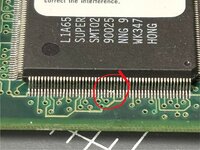
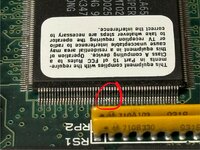
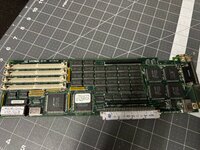
I picked up a Thunder/24 card, and had a concern before trying it out. It appears a few pins of U5 are bridged (see photos). Is this normal? Can anyone else with this same card confirm? They don't look intentional, but it also doesn't appear to have been reworked either.
 

Attachments

  • A.jpg
    A.jpg
    211.4 KB · Views: 17
  • B.jpg
    B.jpg
    234.4 KB · Views: 19
  • C.jpg
    C.jpg
    1.2 MB · Views: 17

BFEXTU

Tinkerer
Jul 15, 2022
186
157
43
i think there were different board revs of the original Thunder/24. The one you have appears to include early rework/fixes. And, there were some intentional solder bridges - maybe power/ground and/or tying unused pins, etc. The board is pretty old at this point and considering that it was out in the world, it had to have passed SuperMac manufacturing QA and years of use. So, the intentional solder bridges are probably OK. They look contemporary.

However, in your picture B.jpg, it looks like there is a possible debris short a couple pins to the right of the solder bridge at the heel of the TQFP pins...and there may be others. And, in general, the board looks somewhat dusty and is in need of cleaning -- and that could be impacting the board operation.

Carefully pop the ROM with a puller or small, flathead screwdriver, protect any labels you care about and then clean and rinse the whole board with IPA and a toothbrush -- especially around all the component legs. Or, if you happen to have a large ultrasonic bath laying around... :D You can also use hot, soapy water, then rinse with IPA - whatever works. Dry thoroughly (use compressed or warm air, if available). Then, inspect for any residual debris shorts -- hopefully no longer there...and the crud should also be gone.

If the debris short in the photo is still there, you may need to use a dental pick, sewing needle or similar tool to carefully remove it (without damaging the device legs).

See the magenta circle around the debris short inside your red circle.
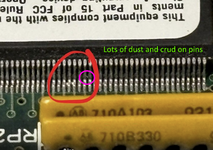
thunder24debris.png
 

Fizzbinn

Active Tinkerer
Nov 29, 2021
261
269
63
Charlottesville, VA
I picked up a Thunder/24 card, and had a concern before trying it out. It appears a few pins of U5 are bridged (see photos). Is this normal? Can anyone else with this same card confirm? They don't look intentional, but it also doesn't appear to have been reworked either.

I see the same IC pins bridged on my two working Thunder/24 cards (1993 v2.0.0a and 1994 v3.0.0 ROM versions).
 

BFEXTU

Tinkerer
Jul 15, 2022
186
157
43
I will also confirm when I locate my boards. But, original and later rev Thunder/24 (circa 1992, etc.) definitely had intentional solder bridges. Ideally, the bridges could have been integrated at the pad level, but weren't...or I seem to have some dim memories regarding this problem --

1. Early Thunder/24 boards had EMI issues with screen stability/jumpiness during computer activity -- especially hard drive accesses. Floating lines may have been a contributing factor for SMT02 (graphics controller) stability. So, if the bridged pins ohm to ground, then that may explain it. it could have been to keep them from floating and causing internal EMI-related stability issues.

2. Even though SuperMac boards had similar designs -- like Thunder and later PDQ Plus et. al. (Thunder without the RAM slots and a gimped ROM to reduce performance), rev changes to later boards didn't necessarily propagate backwards to earlier designs. So, there may have been some remaining issues that might have been fixed in PDQ Plus that remained in Thunder/24. So, if there is no bridging on SMT02 on PDQ Plus, that indicates that the PDQ Plus rev incorporated changes that Thunder/24 did not have.

3. There may have been something about dev/future options vs. short-term manufacturing rework that had to do with not putting the bridges in at pad level. Hmmm...a bit hazy. Oh, maybe it was similar to #2 above, where the manufacturing process was already in place and it wasn't worth the overhead to fix the issues, roll the rev, retest, etc. vs. other more pressing development issues. In startups like SuperMac, there were always too many projects and never enough people or time to maintain the breakneck pace of new product releases.
 
  • Like
Reactions: JDW

BFEXTU

Tinkerer
Jul 15, 2022
186
157
43
I just looked at my PDQ+/PopTart board and there's no pin bridging on SMT02 at that location. However, I ohmed the pins and they are shorted. So, for PDQ+, the change was integrated into the design. As above, the PDQ+ went through re-layout to remove the RAM slots from Thunder/24, but the change also incorporated fixes for other issues.

The other board to check would be a "Thunder IV" board. It is just a rebranded Thunder/24, but should be the same and maybe with a board spin. No pin shorts = relayout (but otherwise, it's the same board). I have one laying around here somewhere. I will try to find it...or maybe someone else has faster access.

And, btw, for those of you with an SMT02 Spectrum/24 PDQ+ (not Spectrum/24 PDQ!) boards, just put a Thunder/24 (IV) ROM in it. It will work and give you faster graphics acceleration. ;)

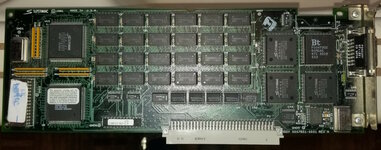
If your board looks like the one below, you can turn it into a Thunder/24, albeit without GWorld RAM:

supermac-poptart.jpg

( If you're wondering about the scrappy ROM label, it is a Thunder/24 v1.16 ROM that I burned in 1992. :D Also, in this picture, you can see the much cleaner layout for SMT02 that brings top-side pins out to a symmetric via pattern, etc. -- and more board real estate since there are no GWorld RAM slots.)
 
Last edited:
  • Like
Reactions: Garrett

JDW

Administrator
Staff member
Founder
Sep 2, 2021
2,542
1,993
113
54
Japan
youtube.com
Seams like everyone loved the keyword "thunder" in those days because I have a Radius Thunder 24/GT which isn't related to the SuperMac "Thunder" series that I can see...

1767917866498.png
 
  • Like
Reactions: BFEXTU

BFEXTU

Tinkerer
Jul 15, 2022
186
157
43
The Thunder/GT was post-merger. 3 years later and different design...but similar nextgen/Radius-branded chips -- graphics controller, accelerator, bitshift register, etc.
 
  • Like
Reactions: JDW

Fizzbinn

Active Tinkerer
Nov 29, 2021
261
269
63
Charlottesville, VA
I will also confirm when I locate my boards. But, original and later rev Thunder/24 (circa 1992, etc.) definitely had intentional solder bridges. Ideally, the bridges could have been integrated at the pad level, but weren't...or I seem to have some dim memories regarding this problem --

1. Early Thunder/24 boards had EMI issues with screen stability/jumpiness during computer activity -- especially hard drive accesses. Floating lines may have been a contributing factor for SMT02 (graphics controller) stability. So, if the bridged pins ohm to ground, then that may explain it. it could have been to keep them from floating and causing internal EMI-related stability issues.

2. Even though SuperMac boards had similar designs -- like Thunder and later PDQ Plus et. al. (Thunder without the RAM slots and a gimped ROM to reduce performance), rev changes to later boards didn't necessarily propagate backwards to earlier designs. So, there may have been some remaining issues that might have been fixed in PDQ Plus that remained in Thunder/24. So, if there is no bridging on SMT02 on PDQ Plus, that indicates that the PDQ Plus rev incorporated changes that Thunder/24 did not have.

3. There may have been something about dev/future options vs. short-term manufacturing rework that had to do with not putting the bridges in at pad level. Hmmm...a bit hazy. Oh, maybe it was similar to #2 above, where the manufacturing process was already in place and it wasn't worth the overhead to fix the issues, roll the rev, retest, etc. vs. other more pressing development issues. In startups like SuperMac, there were always too many projects and never enough people or time to maintain the breakneck pace of new product releases.

At quick glance I see a resistor bodge on my 1994 Thunder/24 card that my 1993 card does not have, on the IC above the 40MHz crystal:

IMG_8563.jpeg


IMG_8562.jpeg
 

BFEXTU

Tinkerer
Jul 15, 2022
186
157
43
@Fizzbinn - That resistor looks like a possible 10K pull-up to VCC on the LS259 - for Q0 or Q1. Or, instead of VCC, it could be connected to _Clear (but VCC might make more sense). Hard to tell exactly from the picture. What specific pins is it bridging? Maybe an overhead shot would help...or here is the rotated pin diagram:

LS259.png
 

Fizzbinn

Active Tinkerer
Nov 29, 2021
261
269
63
Charlottesville, VA
@Fizzbinn - That resistor looks like a possible 10K pull-up to VCC on the LS259 - for Q0 or Q1. Or, instead of VCC, it could be connected to _Clear (but VCC might make more sense). Hard to tell exactly from the picture. What specific pins is it bridging? Maybe an overhead shot would help...or here is the rotated pin diagram:

View attachment 25852

It's bridging 16 (Vcc) and 4 (Q0)

IMG_8565.jpeg
 
  • Like
Reactions: BFEXTU

BFEXTU

Tinkerer
Jul 15, 2022
186
157
43
OK - so a 10K (Brown-Black-Orange-Gold) pull-up on Q0.

The SuperMac accelerator boards have an onboard data/config register. It might be the 2 LS259 devices, or 16 bits of parallel/readable data (with 6 corresponding address lines for serial programming). One possibility is that, for example, the Q0 pull-up might set the Rider Enable bit (accelerator enable) to ON by default. I'll think about it. It could also be that it's latching a 16-bit address or data value for some other reason. (It could also be some other config bit.)

Since you have both boards, if you wanted to try an experiment, you could:
1. use the 2.0 ROM
2. clear PRAM
3. Install the board
4. boot
5. put the board in 24-bit mode
6. check the accelerator status

Then repeat these steps for the other board.

If the accelerator in on by default for the board with the resistor and off for the board without it, then you know that Q0 of that device is probably the Rider Enable bit. If you don't see any different behavior, then this theory is incorrect. Or, you may notice some other configuration detail that is different.

Anyway, I'll think about it and check with a couple of other my other engineering buddies. Maybe I will recall something useful or remember some more details.
 

BFEXTU

Tinkerer
Jul 15, 2022
186
157
43
OK - so that would certainly work, but I'm being dumb. Just boot either board, toggle the accelerator in SuperVideo and carefully probe the Qn pins on both devices to see if any of them toggle. Then you will know which one, if any, is the Rider enable bit. And if so, then the LS259s are the onboard data register.

...and I can wire it up on my analyzer later. The logic analyzer is definitely the best way to go to discriminate among register vs. address vs. data or something else. If the board uses the LS259s for 16-bit address or data, it should be easy to tell on the analyzer with a little Macsbug poking.
 
Last edited:

Garrett

Tinkerer
Oct 31, 2021
146
141
43
South Carolina
i think there were different board revs of the original Thunder/24. The one you have appears to include early rework/fixes. And, there were some intentional solder bridges - maybe power/ground and/or tying unused pins, etc. The board is pretty old at this point and considering that it was out in the world, it had to have passed SuperMac manufacturing QA and years of use. So, the intentional solder bridges are probably OK. They look contemporary.
Just to close the loop on this for others following along. I did test the card in my IIci last night, and it works perfectly. Those that say the pins are bridges intentionally would seem to be correct. Thanks all for the responses!

I see there's a v3 ROM dump for this card - would that provide any benefits other than PPC compatibility?
 
  • Like
  • Love
Reactions: JDW and BFEXTU

BFEXTU

Tinkerer
Jul 15, 2022
186
157
43
Sorry - I missed the question at the end of your post. I think the latest ROM for Thunder/24 is v3.1. It probably fixes some bugs vs. 3.0 -- and yes, it has PPC compatibility. It may also have additional monitor configs vs. earlier ROMs -- not sure...and may require SuperVideo 3.0.

Historically speaking, SuperVideo 2.xx was the shipping version for earlier Thunder/24 ROMs -- pre-2.0 in late 1991 going into 1992. SuperVideo 3.0 was still in development during that time and eventually shipped later in 1992-93 to replace SuperVideo v2.7? Otherwise, in mid-1992, the version of SuperVideo was v2.49. SuperVideo 3.0 was a rewrite in C/C++ vs. the earlier version that was written in MPW Pascal and evolved forward from 1987-1992.
 
  • Like
Reactions: JDW