

Hi all,
I program a lot of ROMs and GALs for the boards I make, and I got tired of booting a Windows machine every time just to run Xgpro. minipro works on the Mac, but typing "SST39SF040@PLCC32" into Terminal 10 times a day gets old fast. So I wrapped it in a proper Mac app.
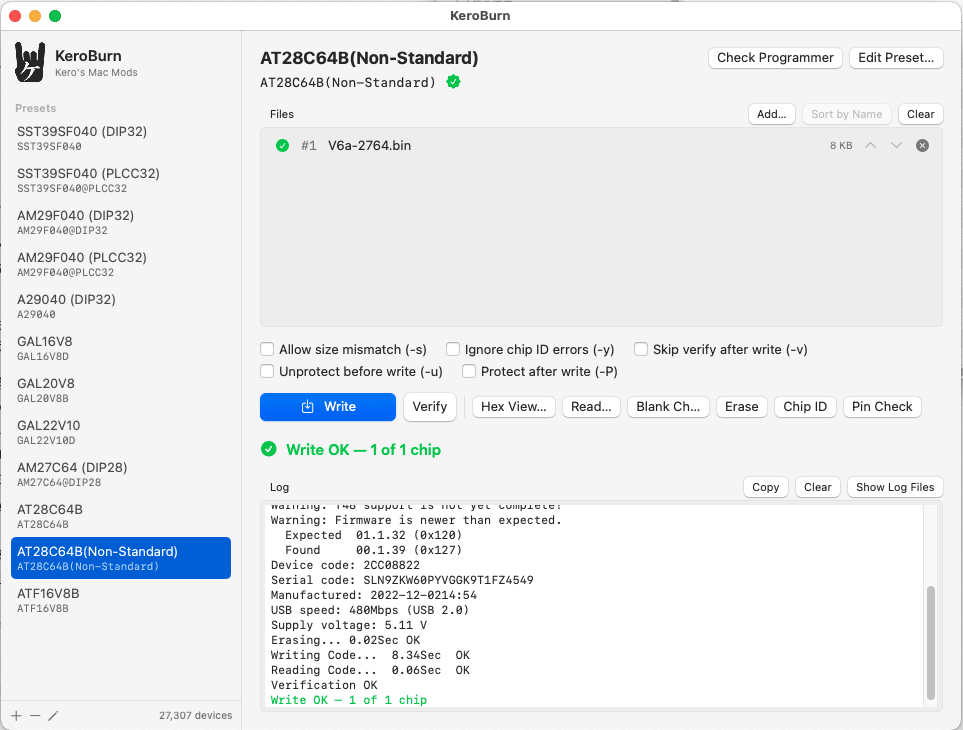
It's called KeroBurn. It's a front end for minipro, and minipro, libusb and the device database are all bundled inside, so there's no Homebrew or MacPorts to deal with. Universal binary, macOS 12 or later.
What it does:
- Presets for the chips you use. The editor searches minipro's T48 database as you type, and shows a green check if the name is valid.
- Drag a .bin (or .jed) onto the window and hit Write.
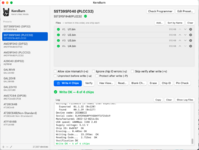
- Multi-chip runs. Drop a HI/LO pair or a 4-chip ROM SIMM set and it flashes them in order, stopping between each one so you can swap chips. Handy for ROM-inator or SMC ROM SIMM sets.
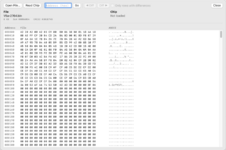
- Hex View. Load the file, read the chip back, and it shows both side by side with the mismatched bytes in red. It also tells you if the data looks shifted to a different address, or if all the errors land on even or odd bytes (which is usually a HI/LO mix-up).
- Sum and CRC32 for the file and the chip.
- A log of every chip written, with the file's SHA-256.
- Checkboxes for -s, -y, -v, -u and -P, saved per preset.
Download (beta):
https://github.com/kerokero5150/KeroBurn/releases/tag/v1.0-beta2
New
Pin contact test on the T48. KeroBurn checks every leg before it writes and stops if one isn't touching. The log draws the socket so you can see which pin it is. minipro only had this for the TL866II+, so KeroBurn ships its own patch for the T48.
The TL866II+ pin check now draws the socket map too.
"Ignore pin check" option per preset, if you want to skip it.
Status bar showing the current step (checking pins, erasing, writing, verifying) and how long it's taking.
Clearer error messages for bad contact, overcurrent, chip ID mismatch and verify failures.
ATF16V8B and ATF22V10C presets. Atmel ATF parts need these instead of the GAL presets, otherwise you get "Overcurrent protection!".
Source is on GitHub too, GPLv3 like minipro:
https://github.com/kerokero5150/keroburn
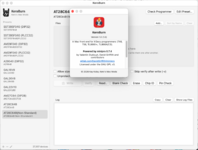
It's not notarized, so the first time you'll need to right-click it and choose Open.
What I've tested: an Intel Mac Pro with a T48 on firmware 00.1.39. SST39SF040 in PLCC32, AT28C64B, ATF16V8B and a few others all flash and verify fine.
What I haven't tested, and where I'd really like help:
- Apple Silicon. It builds as a universal binary, but I don't have an M-series Mac to run it on.
- The T56 and TL866II+. minipro supports them, I just don't own one.
One known oddity: my AT28C64Bs fail verify with the normal device name. Only the first and last byte of each 64-byte page get written. Switching to "AT28C64B(Non-Standard)" fixes it. My chips are recycled pulls though, so I'm not sure if it's the T48 or the chips. If you have genuine Atmel parts I'd like to know how they behave.
Bug reports here or on GitHub issues are both fine. Thanks for trying it.
I program a lot of ROMs and GALs for the boards I make, and I got tired of booting a Windows machine every time just to run Xgpro. minipro works on the Mac, but typing "SST39SF040@PLCC32" into Terminal 10 times a day gets old fast. So I wrapped it in a proper Mac app.
It's called KeroBurn. It's a front end for minipro, and minipro, libusb and the device database are all bundled inside, so there's no Homebrew or MacPorts to deal with. Universal binary, macOS 12 or later.
What it does:
- Presets for the chips you use. The editor searches minipro's T48 database as you type, and shows a green check if the name is valid.
- Drag a .bin (or .jed) onto the window and hit Write.
- Multi-chip runs. Drop a HI/LO pair or a 4-chip ROM SIMM set and it flashes them in order, stopping between each one so you can swap chips. Handy for ROM-inator or SMC ROM SIMM sets.
- Hex View. Load the file, read the chip back, and it shows both side by side with the mismatched bytes in red. It also tells you if the data looks shifted to a different address, or if all the errors land on even or odd bytes (which is usually a HI/LO mix-up).
- Sum and CRC32 for the file and the chip.
- A log of every chip written, with the file's SHA-256.
- Checkboxes for -s, -y, -v, -u and -P, saved per preset.
Download (beta):
https://github.com/kerokero5150/KeroBurn/releases/tag/v1.0-beta2
New
Pin contact test on the T48. KeroBurn checks every leg before it writes and stops if one isn't touching. The log draws the socket so you can see which pin it is. minipro only had this for the TL866II+, so KeroBurn ships its own patch for the T48.
The TL866II+ pin check now draws the socket map too.
"Ignore pin check" option per preset, if you want to skip it.
Status bar showing the current step (checking pins, erasing, writing, verifying) and how long it's taking.
Clearer error messages for bad contact, overcurrent, chip ID mismatch and verify failures.
ATF16V8B and ATF22V10C presets. Atmel ATF parts need these instead of the GAL presets, otherwise you get "Overcurrent protection!".
Source is on GitHub too, GPLv3 like minipro:
https://github.com/kerokero5150/keroburn
It's not notarized, so the first time you'll need to right-click it and choose Open.
What I've tested: an Intel Mac Pro with a T48 on firmware 00.1.39. SST39SF040 in PLCC32, AT28C64B, ATF16V8B and a few others all flash and verify fine.
What I haven't tested, and where I'd really like help:
- Apple Silicon. It builds as a universal binary, but I don't have an M-series Mac to run it on.
- The T56 and TL866II+. minipro supports them, I just don't own one.
One known oddity: my AT28C64Bs fail verify with the normal device name. Only the first and last byte of each 64-byte page get written. Switching to "AT28C64B(Non-Standard)" fixes it. My chips are recycled pulls though, so I'm not sure if it's the T48 or the chips. If you have genuine Atmel parts I'd like to know how they behave.
Bug reports here or on GitHub issues are both fine. Thanks for trying it.
Last edited:


