WON'T POWER ON: PowerBook Wallstreet PDQ

JDW

Administrator
Staff member
Founder
Sep 2, 2021
2,870
2,230
113
55
Japan
youtube.com
I have two PowerBook Wallstreet PDQ notebooks that once worked fine several years ago), but now neither will power-on when I press the POWER button (long or short press).

When I first plug-in the Apple AC Adapter, the fan spins at full blast and the green power LED lights for a couple seconds, and then the fan and LED power off. After that, pressing the power button does nothing.

I have no working battery anymore, so I only have AC power from the stock adapter. I've tested both PDQ machines with nothing in either drive bay and with even the hard drive removed, but to no avail. Both PDQ machines respond in the exact same way — power button doesn't power them on, despite my hearing the fan spin and LED light initially after connecting the AC Adapter. I've swapped their CPU cards, but again, it doesn't resolve the problem.

Here's a video overview of what I explained and mentions a couple voltage measurements I made too...


Wallstreet repair experts...
How can I fix these machines?
 

JDW

Administrator
Staff member
Founder
Sep 2, 2021
2,870
2,230
113
55
Japan
youtube.com

JDW

Administrator
Staff member
Founder
Sep 2, 2021
2,870
2,230
113
55
Japan
youtube.com
Well, the verdict is in. Recapping does nothing to fix these problems.
My gut instinct was 100% correct.

More specifically, I replaced all 5 electrolytic capacitors with high quality polymer capacitors. Absolutely no changes in machine behavior occurred after recap. After reassembly and connecting the AC Power Adapter, pressing the power button did nothing. After waiting 24 hours, pressing power also did nothing (as usual). I waited another 24 hours and pressing power worked. The machine was on for just under 1 hour, then it suddenly lost power. So no, recapping a Wallstreet PDQ does NOT fix any of the issues I have mentioned throughout this thread.

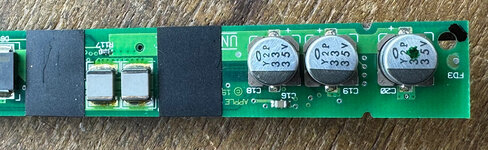
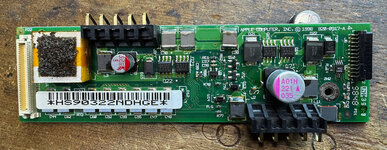
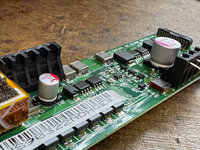
The two PCBs recapped sit between the drive bays. High resolution photos showing the stock capacitors are here ("Primary DC Board with Daughtercard Attached" & "Daughtercard"):

CAPACITOR INFO​

(DE-5000 was used to make measurements)​


C49​

STOCK CAPACITOR​

Frequency Tested: 120Hz
Capacitance: 31.9µF
D = 0.075
Q = 12.79
ESR: 3.2Ω
θ = -85.6°

REPLACEMENT CAPACITOR (C49)​

(Wurth Aluminum Organic Polymer 875105545004)​

Frequency Tested: 120Hz
Capacitance: 34.82µF
D = 0.015
Q = 67.8
ESR: 0.5Ω
θ = -89°

C18​

STOCK CAPACITOR​

Frequency Tested: 120Hz
Capacitance: 32.39µF
D = 0.065
Q = 15.21
ESR: 2.7Ω
θ = -86.2°

C19​

STOCK CAPACITOR​

Frequency Tested: 120Hz
Capacitance: 32.6µF
D = 0.092
Q = 11
ESR: 3.5Ω
θ = -84.9°

C20​

STOCK CAPACITOR​

Frequency Tested: 120Hz
Capacitance: 32.26µF
D = 0.065
Q = 15.55
ESR: 2.5Ω
θ = -86.4°

REPLACEMENT CAPACITORS (C18/19/20)​

(Kemet Polymer Tantalum T521V336M035ATE065)​

Frequency Tested: 120Hz
Capacitance: 36.04µF
D = 0.007
Q = 137.5
ESR: 0.2Ω
θ = -89.5°

C71​

STOCK CAPACITOR​

Couldn't measure because my hot tweezers weren't wide enough to get around the cap, and my attempt at using dual soldering irons failed. So I had to remove it by the twist-off method. Pads were OK, but the cap seems to have been destroyed in the process because I couldn't get any reading from it after removal.

REPLACEMENT CAPACITOR (C71)​

(Kyocera AVX Aluminum Organic Polymer APA1010221M035R)​

Frequency Tested: 120Hz
Capacitance: 215.6µF
D = 0.021
Q = 45.3
ESR: 0.1Ω
θ = -88.6°


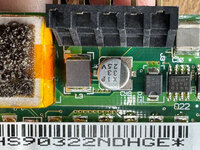
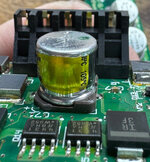
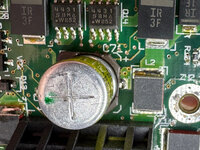
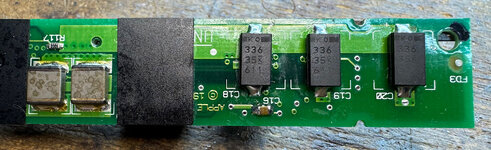
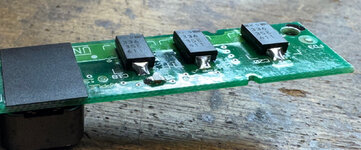
STOCK CAP PHOTOS (all 5 caps)​

C18-19-20-stock_TopDown.JPG​

C49-stock_TopDown.JPG

C71-stock_SideViewZoom.JPGC71-stock_TopDownZoom.JPG

​

REPLACEMENT CAP PHOTOS (all 5 caps)​

C18-19-20_TopDown.JPG
C18-19-20_SideView.JPG
C49_C71_TopDown.JPG
C49_C71_SideView.JPG

Shouldn't you replace electrolytic caps that are more than 25 years old? Yes! But that is a different topic. The point here is that recapping doesn't fix the "won't power on" and "sudden power loss" issues inherent to many Wallstreet PowerBooks.

Now I'm back to square one, trying to figure out what's wrong.

:cry:
 

JDW

Administrator
Staff member
Founder
Sep 2, 2021
2,870
2,230
113
55
Japan
youtube.com
I appreciate your reply.

A "weak power line" is a phrase that is extremely broad. Technically, any PCB trace that carries 5V or 12V power is a "power line" throughout the entire machine. So because that statement doesn't nail down a specific location in the machine, it's not a question I can answer.

With that said, some people who own Wallstreet machines have reported that replacing the PMU PCB resolves "won't power on" issues, although I seem to be the lone person on the planet who is also experiencing "sudden power loss" after the machine has powered up. That could be because in the past, more people had working batteries, and even I myself don't remember having these issues when I had a working battery. But on AC power only, I do have the problems.

Anyway, the PMU PCB is technically the board that is the "Power manager" you refer to. I don't know if it handles Soft Power though. But it would be correct to call the pressing of the Power button "soft power" insofar as that button doesn't directly make/break connections to the external AC Power Adapter.

The main issue is, we don't know precisely WHERE inside the machine the problem lies.

If we argue it is the PMU board, why is it that board? What chip on that board is "failing"?

Assuming it is the PMU board, we cannot say the PMU board has 100% failed because I can power-on my PDQ if I leave it connected 48 hours, but then it loses power suddenly about an hour later. That is the most perplexing part of this entire problem. The machine works a little bit, but not completely. It's weird. And I cannot say if a PMU PCB swap is the magic fix because that is just a guess based on case reports I dug up on the internet. Sadly, there isn't much talk about the Wallstreet machines out there. This thread is perhaps the most detailed of anything I've come across thus far.

I just fired off an email to Nick Gillard of 1-bit Rainbow in the UK since I've bought from him before, and he has various Wallstreet parts I could use. It's just kind of pricey to get "all the parts," so nailing down what might work is key. I asked for his opinion and am waiting for his feedback. Maybe he can offer some good insights.
 

Kai Robinson

Co-Founder, Emeritus Board Member
Staff member
Founder
Sep 2, 2021
1,422
1
1,440
113
44
Worthing, UK
What happens in the old PC World, is something called 'Load Line Calibration' - sure you may set a voltage to say 1.8v, and under idle, it'll be around 1.78 to 1.79v, close enough - but the moment the part is under load, the voltage sags to say 1.6v, which may be out of margin. It would be worth monitoring the voltages coming off the pins to the board - to see what they are in power off state and what they are when it's on (if you can get it to turn on) - is there any reference as well as to the voltage that's supposed to be output?

https://tinkerdifferent.com/members/the-house-of-moth.49/ May have schematics for this PB?
 

JDW

Administrator
Staff member
Founder
Sep 2, 2021
2,870
2,230
113
55
Japan
youtube.com
Some good but strange happenings today.

First off, I bought enough replacement caps for both of my machines, so I decided to also recap the "dead" PDQ. I measured the caps I removed, and the data is comparable to the caps taken off the other PDQ (i.e., no indication they were bad)...

CAPACITOR MEASUREMENTS​

(DE-5000 was used to make measurements)​


C49​

STOCK CAPACITOR​

Frequency Tested: 120Hz
Capacitance: 31.9µF
D = 0.105
Q = 9347
ESR: 4.3Ω
θ = -83.9°

C18​

STOCK CAPACITOR​

Frequency Tested: 120Hz
Capacitance: 30.98µF
D = 0.067
Q = 14.84
ESR: 2.8Ω
θ = -85.9°

C19​

STOCK CAPACITOR​

Frequency Tested: 120Hz
Capacitance: 31.4µF
D = 0.067
Q = 14.96
ESR: 2.8Ω
θ = -86°

C20​

STOCK CAPACITOR​

Frequency Tested: 120Hz
Capacitance: 31.46µF
D = 0.062
Q = 15.85
ESR: 2.6Ω
θ = -86.3°

C71​

STOCK CAPACITOR​

Once again, I couldn't measure it because I had to use the twist-off removal method, which destroys the cap.


Here's the strange part.​

As I was slowly reassembling the machine, I used my lens to examine the logic board circuitry to see if I could spot burned components. Nope. All look fine. I did notice a teensy tiny bit of crud near one of the connectors soldered to the logic board nearest the drive bays, and I did a tiny bit of scraping there, but not much. I found some hairs and other debris too, which I removed -- but nothing significant.

After that, I decided to remove the DC board at back -- the one with the barrel plug that you connect your external power brick too. I had desoldered that to the DC board in the past, but I didn't use flux at that time so my solder balls on bottom were pretty massive, and I decided to clean those up by removing some of the solder. I used 450°C to do that.

I finished reassembly and connected the external AC power brick (my modern one, which is new). I heard the fan spin up for several seconds, which is normal. I then pressed the power key, and to my shock, the machine gave me a boot chime. It booted at 1:37pm and it's still booted and going strong (I'm doing a HDD surface scan) at 6:07PM. That's 4.5 hours. Even my "good" PDQ wouldn't stay alive for that long.

Strange. Very strange. I know from my other PDQ that recapping has NOTHING to do with resolving these problems. So it was either my minor crud removal or desoldering of the barrel plug.

The only down side is that only my right speaker works. I did the sound test which tests sound in both speakers, but the left speaker gets no sound. Another problem is that some keys on the keyboard don't work. Other than that though, this "bad" PDQ seems to now be good. I will need to do a multi-day series of tests to confirm if it boots reliably and doesn't lose power, but this is a giant leap in the right direction, I must say.
 

robertseward

New Tinkerer
Nov 12, 2026
6
2
3
Heat from a soldering iron can reflow a cold joint, but normal operating heat won't melt solder. More likely the recap or DC-board removal disturbed an intermittent joint or connector. Since the DC board was out, I'd reflow the barrel-jack and board-header solder joints, check the jack for a cracked pad, then wiggle the plug while monitoring the rails. That fits the brief fan/LED pulse and later sudden shutdown better than a completely dead PMU.
 
  • Like
Reactions: S. Pupp

JDW

Administrator
Staff member
Founder
Sep 2, 2021
2,870
2,230
113
55
Japan
youtube.com
The machine that I got working by way of resoldering the barrel connector is back to its dirty stinking tricks again. I was pleased to see that the LED was blinking when I arrived at the office today. It was sleeping nicely the entire weekend. But when I opened the lid and pressed a key, nothing happened. I pressed the power key, but nothing. I then fiddled with the AC Adapter connection on back for a half a second by just pushing on it a little bit. I then pressed the power key and the machine booted. Makes zero sense because the solder connections are perfect this time. And I was using my brand new, modern AC Adapter with brand new adapter, so it cannot be a bad connection from that.

Anyway, the machine started to boot and then complained that the built-in memory tests detected a problem with RAM. I opened System Profiler and it only saw the upper RAM module. I powered off, removed the CPU card (while being grounded of course), removed both RAM modules, swapped them, reassembled, pressed power, but got nothing. It's back to not booting now.

And yes, this is the machine I used DeOxit D5 on the connections. Not only the CPU card connections, but the RAM sockets too.

I'm so frustrated I could scream!
 

JDW

Administrator
Staff member
Founder
Sep 2, 2021
2,870
2,230
113
55
Japan
youtube.com
@S. Pupp I take that to mean you had the same problems I've been mentioning in this thread?

Honestly, I've had a hard time believing it is just me and just my two PDQ machines. Surely this must be more widespread. Yet, there are few fellow PDQ owners who've chime in with something to add to this thread. Maybe most threw out their machines long ago. Quite sad, because the PDQ is an otherwise great "bridge machine" to have (if and only if it works reliably).
 

JDW

Administrator
Staff member
Founder
Sep 2, 2021
2,870
2,230
113
55
Japan
youtube.com
Friends, something new just happened.

Last night, I left both of my PDQ machines connected to their respective AC Adapters. Leaving the machines that way overnight (but often for 48 hours) sometimes allows the machines to boot. I pressed the power key on the first machine but got nothing. I then did the same on the other and got the boot chime, but 2-3 seconds later, I heard a brief sound from the speaker which sounded like broken glass. Any thoughts on what that might be? Nothing appeared on screen and there was no sign of life after that. And pressing the power key after that did nothing, although a PMU reset would spin the fan, as it always does.
 

This Does Not Compute

Emeritus Board Member
Staff member
Oct 27, 2021
374
536
93
www.youtube.com
I seem to recall some machines having different sounding Sad Mac chimes. There's at least one Power Mac out there that makes the sound of a car crash, and your mention of broken glass sounds oddly familiar to me, though I can't remember if it's relevant to the PDQ.
 
  • Like
Reactions: JDW

NJRoadfan

Tinkerer
Feb 6, 2022
109
37
28
The car crash noise sounds about right for a PDQ/Wallstreet. This problem WAS widespread and likely retired quite a few machines. I know it did for my friend. I still wouldn't be surprised if there was a common failure on one of the boards like a bad transistor or some other passive besides a capacitor. Apple seems to have solved it on later G3s though. Never had this problem with my Lombard or the myriad of iBook G3s I've had over the years.