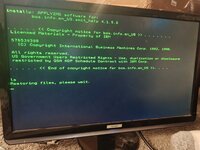
This is wonderful news @trag !! I know @ClassicHasClass and I are standing by. Please let us know if here is any other way we could help 
I used kansas_deinterleave to deinterleave all the ROMs. I think most people just want ANS 2.0.
This four chip arrangement is not flashable by Apple's flash utility which expects different chips.
Also, your ROM DIMMs won't have the write enable pin wired so we can't make our own flash utility?
Yes. That's the only one with 1 MiB files.ANS 2.0 means the first one above, "ANS Deinterleaved.zip"?
Any reason to not connect them?That is correct. Actually, I made a provision to enable the WP pin to all of the chips from the WP pin(s) on the DIMM. It's been 20 years since I laid the thing out. IIRC, connecting them requires installing a couple of 0 ohm resisters and maybe a wire jumper.
Code for flashing various chips exists in New World Mac firmware updaters (Open Firmware code), and in open source utilities such as flashrom. I have a fork of flashrom for Mac OS X.But certainly, it would require your own programming utility, which follows the programming requirements for the HY29F800 from Hyundai or Hynix (same procedure for both). There's some theoretical discussion about programming in the large PEx thread I linked above.
I'll read those later. I was thinking, could the ROM DIMM have a switch to disable itself so that I can boot my Power Mac 8600 into its built-in version of Open Firmware, load firmware updating code from disk or serial port, then use the switch to enable the DIMM (bypass the built-in ROM), then run the firmware updating code? That way, I could use the Power Mac 8600 as a programmer for itself or other Macs. It would be useful for ANS since ANS doesn't have built-in ROM.My thought was to build an external programmer similar to Doug's mechanism for the Mac II family.
This is probably the first posting in that speculation: https://68kmla.org/bb/threads/pex-rom-project.23568/post-417941
And here is a later post laying out some of the solid options. Never got any further as far as building/testing hardware: https://68kmla.org/bb/threads/pex-rom-project.23568/post-418272
Any reason to not connect them?
I'll read those later. I was thinking, could the ROM DIMM have a switch to disable itself so that I can boot my Power Mac 8600 into its built-in version of Open Firmware, load firmware updating code from disk or serial port, then use the switch to enable the DIMM (bypass the built-in ROM), then run the firmware updating code? That way, I could use the Power Mac 8600 as a programmer for itself or other Macs. It would be useful for ANS since ANS doesn't have built-in ROM.
Apple flashing schematics were linked at
https://68kmla.org/bb/threads/mac-os-on-ans-modding-a-rom-dimm.51120/post-578579
Apple's flashing utility (for classic Mac OS) could be updated to add support for other chips. However, I don't think you can boot Mac OS, then disable the built-in ROM while Mac OS is running unless you disable interrupts and exceptions. So in this case, the ROM DIMM must already have a ROM that works with the Mac.
Cameron,Yay @trag! @johntucker found two versions, the pre-production ROM and the 2.0 ROM. It turns out I also have a pre-production ROM (it hashes the same as his), and I also have the 2.6 NT ROM thanks to @dbinreno .
However, the 2.0 ROM is the one we're most interested in because that has drivers for allowing the internal video and SCSI to be used in MacOS. With luck it will also boot Rhapsody.
I can split up the files for programming if you let me know how they should be cut up.
I don't know how I never noticed this thread until now. Visiting here too seldom.
I can make copies of those ROMs, but will need some help processing the dumps to get them ready. I still have thirteen blank ROM circuit boards and hundreds of flash chips.
Process the dumps. Program them onto chips, solder the chips to boards. Done. Probably only take me 8 or 10 years based on past experience.
Seriously, I don't have a lot of attention to spare, but can probably get it done, if someone else will take the lead on getting the files to be programmed massaged as needed.
The ROM module in the X100, the X500 and X600 Macs, the ANS, the Beige G3 and the PowerExpress are all the same physically, although the Beige G3 is wired for 3V supply, instead of 5V supply.
Here's the saga of making the ROMs for the PowerExpress:
PowerExpress (9700) ROM Thread
Which also covers in some detail the process of going from 4 MB dump to four files suitable for programming on X16 flash chips.
Not sure if I referenced any files in my old webspace in there. My ISP changed since then, so if I did, referenced files would be here:
https://sphinxgroup.org/Firmware/
If more than thirteen modules are needed, I still have the board design and JLCPCB was pretty cheap to produce the previous 20 I made. In fact, I think the gerber files are in the folder referenced above.
I've also used this design to make Rev. B and Rev. C ROM modules for the Beige G3 (adds 2 drive support on ATA busses), and Kansas ROM modules for the X500/X600, which doesn't really do much, but in theory should make speculative processing work properly with G3 upgrades on those machines.
Is there a story behind how John found the ROMs? I didn't read the thread in as much detail as I should, but I gathered he found two versions and that Classichasclass found another?
In case anyone doesn't ahve it I've attached the Apple Hardware Developer Note for the ANS. I'm much more a hardware guy than a software guy.
The main differences between the ANS and the PowerMac 9500/9600 is that the ANS has ten PCI devices where the PM9500 only has 7 (six slots + Grand Central). The ANS adds the 53C825 SCSI chips and the onboard video chip. Each PCI device gets a unique interrupt (routed through Grand Central) in the Apple universe, so the ten interrupts supported by Grand Central are arranged very differently on the ANS than on the PM9500, which is at least one reason the ROMs for one do not work on the other.
Excellent! I will send you a PM. There is a nice newly recapped logic board and 150MHz CPU card here ready to go in it.Cameron,
I just found this. I still ready and willing to do whatever I can to help just let me know m e know.
I also have a rough plan to get the Deep Dish to you. I am waiting on a restoration shop in southern California
to get around to working on my vantage VW Karmann Ghia. I will have to trailer it so I can bring the ANS to you
during that trip which I hope will be in May or June.
adios,
jt

I figured, thanks. Will recap n let y'all know asap :3Since you have an EVT (similar to mine), I suspect you may have the pre-production ROMs on those. There is no way to tell from the chips themselves without firing it up.
When you are able to boot into Open Firmware, you can use the script atI found this evt2 ans 700, and it looks like it has the same rom.
 (( will have to order.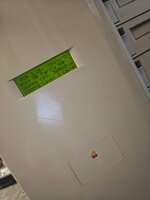
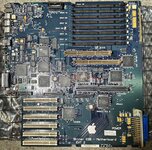
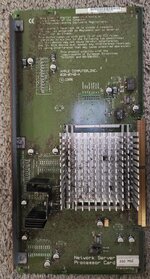
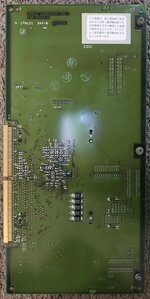
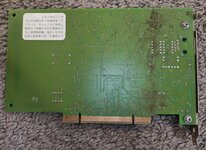
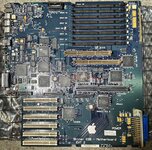
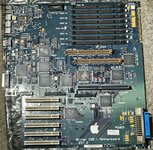
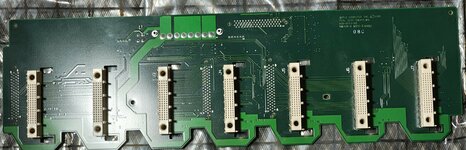
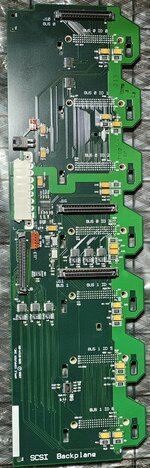
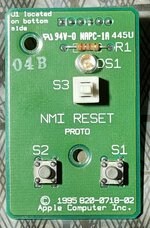
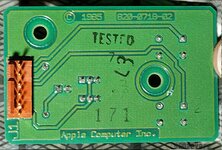
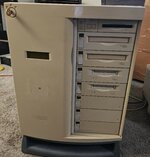
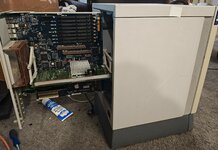
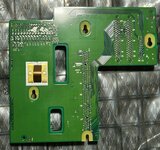
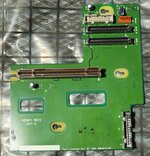
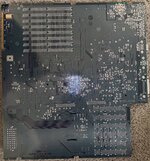
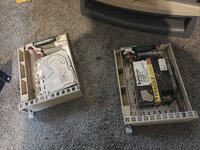
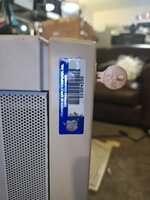
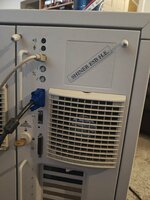
Much later ROM than I would have thought. It would be very interesting to see what's on those hard disks.

I ended up booting into Aix, it recongnized it and surprisingly worked, although no data was on the 4gb drive from what I could tell digging around in it... the quantum has been turned into an iso as previously mentioned. installed AIX to bluescsi.Apple Network server EVT2 dump : Free Download, Borrow, and Streaming : Internet Archive
A dump of images and an iso image of the hard drive from my Apple network server evt2 I found, it came with 2 drives but as of currently one does not work.archive.org
one drive doesn't work, I think, still tryna work on it
Apple Driver Map, blocksize 512, blockcount 2503871, devtype 0, devid 0, driver count 2, contains[@0x200]: Apple Partition Map, map block count 6, start block 1, block count 63, name Apple, type Apple_partition_map, contains[@0x400]: Apple Partition Map, map block count 6, start block 64, block count 54, name Macintosh, type Apple_Driver43, processor 68000, boot arguments ptDR, valid, allocated, in use, has boot info, readable, writable, pic boot code, real driver, chain driver, contains[@0x600]: Apple Partition Map, map block count 6, start block 118, block count 74, name Macintosh, type Apple_Driver43, processor 68000, valid, allocated, in use, has boot info, readable, writable, pic boot code, real driver, chain driver, contains[@0x800]: Apple Partition Map, map block count 6, start block 192, block count 512, name Patch Partition, type Apple_Patches, contains[@0xA00]: Apple Partition Map, map block count 6, start block 704, block count 2503158, name untitled, type Apple_HFS, valid, allocated, in use, has boot info, readable, writable, pic boot code, real driver, chain driver, mount at startup, is the startup partition, contains[@0xC00]: Apple Partition Map, map block count 6, start block 2503862, block count 10, name Extra, type Apple_Free
You haven't hijacked this post at all - it's good to see an Shiner ESB system running again. Since you bought it from Texas, you may have one of the Apple Austin systems here. Those were among the last stand of ANS systems at Apple, and ran parts of www.info.apple.com as late as 2005.It came from Texas, presumably where it lived it's entire life, I purchased it off eBay a while ago, and now I feel as though I have highjacked the post haha.