Hacking the Kodak Reels 8mm Film Digitizer (New Thread)

  • Please can you read through and vote on the following proposition for changes to the board structure by clicking here.

larryc39

New Tinkerer
Jan 2, 2025
25
14
3
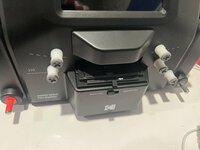
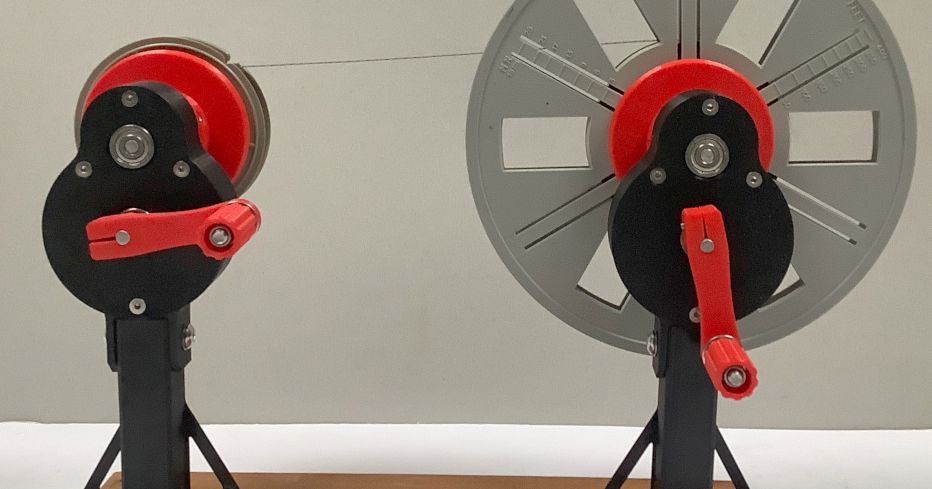
It took me a minute to realize what was going on, that's the front and back view of the knob that is some sort of speed control. I was looking at it and thinking why's there a spare reel holder on your unit.
Dumb mistake on my part. I made the channel between the two walls of this design too narrow for the film to pass through. It's been resolved and updated as a v2 part in my original post.
Probably not easy or useful, but the other one, the one that drops in from the top, it would be useful to have keying on it since it's so almost just a square it's easy to install the wrong way.
Don't use iris lens caps, as that introduces vignetting.

The issue is the plastic camera mount, the thread is too easily messed up, I had trouble with it too. Maybe on my next unit, I will print my own extension tube in TPU, soft enough to thread the lens onto, fill customizable length.
OK didn't realize they weren't good to use, seems like some people had success with them.
I did order that pack of lens mounts from Amazon and might try switching mine out. You're right about the threads, it's like they were never intended to be used once the original lens was removed. It feels like the plastic "shrinks" some from the molding and makes it harder to go in like a taper. But could just be bad threads. Looks like I got some dust on the sensor too in the process :( minor cloudy/dark spots on my preview images. Also ordered some micro screw kits so I can put all four screws in the lower and upper mounts going forward. After playing with the focus I see how even just a touch is enough pressure to shift the camera so making the board mount as secure as possible seems like a good idea. Ten pounds of junk drawer screws and nothing that small!
 

0dan0

Active Tinkerer
Jan 13, 2025
407
556
93
It took me a minute to realize what was going on, that's the front and back view of the knob that is some sort of speed control. I was looking at it and thinking why's there a spare reel holder on your unit.

Probably not easy or useful, but the other one, the one that drops in from the top, it would be useful to have keying on it since it's so almost just a square it's easy to install the wrong way.

OK didn't realize they weren't good to use, seems like some people had success with them.
I did order that pack of lens mounts from Amazon and might try switching mine out. You're right about the threads, it's like they were never intended to be used once the original lens was removed. It feels like the plastic "shrinks" some from the molding and makes it harder to go in like a taper. But could just be bad threads. Looks like I got some dust on the sensor too in the process :( minor cloudy/dark spots on my preview images. Also ordered some micro screw kits so I can put all four screws in the lower and upper mounts going forward. After playing with the focus I see how even just a touch is enough pressure to shift the camera so making the board mount as secure as possible seems like a good idea. Ten pounds of junk drawer screws and nothing that small!
These are great for getting dust off the sensor https://www.amazon.com/dp/B0CPFHNPBQ
 

larryc39

New Tinkerer
Jan 2, 2025
25
14
3
For anyone doing dev work or just wants a "front accessible" SD card slot, I bought on of these SD card extension ribbons on Amazon and I find it very helpful:

I hadn't thought of that, but I haven't used mine much yet in earnest. I picked up the bare board version to try, maybe I can find a way to front panel mount it with a bracket and a hole in the front.
1770068673706.png
 
  • Like
Reactions: videodoctor

0dan0

Active Tinkerer
Jan 13, 2025
407
556
93
Are there any other obvious hardware changes aside from the camera board? I see the camera ribbon cable is still as awkward as ever.
I expect they had trouble sourcing AR0330 sensors (12 years old), only the sensor board is changed.
 

videodoctor

Tinkerer
Jan 8, 2026
60
25
18
@0dan0 , I know you just got your D unit yesterday---have you had any luck confirming the expo_iso address yet?

In the hist.c code, I kept running into crashes with the histo_rgb_image value at the start of the calc_histogram function, and as I don't fully understand how the hist[] array works, I had to keep re-initializing the histo_rgb_image value to (uint8_t *)hist[3] + 4; and comment out all of your initial if() statements at the start of the function too, which is likely why it's flashing. I know the calc_histogram is firing without a hiccup as I have a blinking LCD square to show me if there's any delays.
 

ChrisTheChiller

New Tinkerer
Jan 22, 2026
3
6
3
I am still in utter admiration for the energy and dedication you all are putting into fabricating a firmware that helps us getting a decent picture quality out of a seemingly unsatisfying consumer product! 🤩 Thank you for that!

I am currently into the hardware side of things and I tried an el cheapo solution for enhancing the resolution my Kodak is getting with its stock lens.

Simply Because I didn't want to spend another 100 € for a new lens, I thought about just bringing the camera closer to the film strip.

After testing a possible distance, where I still was able to focus, I settled on 12 mm.

Which is about the distance between the screw holes of the camera mount. That way I only had to drill four new holes into the metal plate of the scanning assembly.
new holes.png


After remounting the camera and connecting it again (don't worry, the ribbon cable should be long enough), I could measure how much of the plastic case below it I had to cut away. (about 5 - 6 mm)

Finally I had to modify the camera cover to fit over the lower hanging lens.

The result now looks like this (cover removed for illustration purposes :) )

cam 01.jpg


cam.jpg


With everything in place I refocused the stock lens to match the new height.

Compared to the effort I had put in, I am pretty satisfied with the final result, considering both resolution and overall look of the modification.

Here is a comparison of before and after - both in 1600x1200 (max zoomed out)
Movie0001.MP4_snapshot_00.06_[2026.02.04_08.52.23].jpg
Movie0016.MP4_snapshot_00.17_[2026.02.04_08.52.40].jpg

The effective resolution is now at 1152x864, with a small margin around the actual frame.
res_zoomed 0.jpg


Here is another screenshot of the capture. Given that the actual movie isn't the highest quality, I am still happy with how it turned out
Movie0012.MP4_snapshot_00.01_[2026.02.04_11.06.48].jpg


Here's my final summary:

Advantages :D
  • sourcing of a fitting new Lens unnecessary (cost saving)
  • absolutely no 3D-Printer or other special tools needed,
    just a sharp 4 mm drill, a screwdriver and a knive or a dremel
  • minimal modification of the case (time saving)
  • all can be done within about one hour
  • no change of the overall aesthetic of your scanner
  • mostly easily revertable, if in the future you should decide to go the full mile (with a new lens)

Disadvantages :cautious:
  • not the full possible resolution of 1600x1200 (only 1152x864)
  • the lid of the transport mechanism doesn't open completely
    (but still high enough to easily thread the movie through)


I would love to hear your comments about my approach. For me personally it's totally sufficient, especially in connection with the modded firmware and considering the cost and time savings.
 
Last edited:

0dan0

Active Tinkerer
Jan 13, 2025
407
556
93
I am still in utter admiration for the energy and dedication you all are putting into fabricating a firmware that helps us getting a decent picture quality out of a seemingly unsatisfying consumer product! 🤩 Thank you for that!

I am currently into the hardware side of things and I tried an el cheapo solution for enhancing the resolution my Kodak is getting with its stock lens.

Simply Because I didn't want to spend another 100 € for a new lens, I thought about just bringing the camera closer to the film strip.

After testing a possible distance, where I still was able to focus, I settled on 12 mm.

Which is about the distance between the screw holes of the camera mount. That way I only had to drill four new holes into the metal plate of the scanning assembly.
View attachment 26612

After remounting the camera and connecting it again (don't worry, the ribbon cable should be long enough), I could measure how much of the plastic case below it I had to cut away. (about 5 - 6 mm)

Finally I had to modify the camera cover to fit over the lower hanging lens.

The result now looks like this (cover removed for illustration purposes :) )

View attachment 26614

View attachment 26615

With everything in place I refocused the stock lens to match the new height.

Compared to the effort I had put in, I am pretty satisfied with the final result, considering both resolution and overall look of the modification.

Here is a comparison of before and after - both in 1600x1200 (max zoomed out)

The effective resolution is now at 1152x864, with a small margin around the actual frame.
View attachment 26618


Here is another screenshot of the capture. Given that the actual movie isn't the highest quality, I am still happy with how it turned out
View attachment 26619

Here's my final summary:

Advantages :D
  • sourcing of a fitting new Lens unnecessary (cost saving)
  • absolutely no 3D-Printer or other special tools needed,
    just a sharp 4 mm drill, a screwdriver and a knive or a dremel
  • minimal modification of the case (time saving)
  • all can be done within about one hour
  • no change of the overall aesthetic of your scanner
  • mostly easily revertable, if in the future you should decide to go the full mile (with a new lens)

Disadvantages :cautious:
  • not the full possible resolution of 1600x1200 (only 1152x864)
  • the lid of the transport mechanism doesn't open completely
    (but still high enough to easily thread the movie through)


I would love to hear your comments about my approach. For me personally it's totally sufficient, especially in connection with the modded firmware and considering the cost and time savings.
I originally tried this approach, but don't remember if it was the door position or focus issues that made find the new lens. But 1152x864 is a big improvement, over Type ABC's 752x564. Using the 12mm lens, the active Super 8 frame is 1376x1032 (types ABC). This approach might be prefect for Type D. On the D the Super 8 native frame is 840x624. So we can estimate moving the stock lens closer with get 1286x966 (D), which is more than film resolves anyway. The 12mm will get an estimated 1536x1152, overkill, but I like overkill. ;)
 
  • Like
Reactions: videodoctor

sheider

New Tinkerer
Oct 17, 2025
25
10
3
I am still in utter admiration for the energy and dedication you all are putting into fabricating a firmware that helps us getting a decent picture quality out of a seemingly unsatisfying consumer product! 🤩 Thank you for that!

I am currently into the hardware side of things and I tried an el cheapo solution for enhancing the resolution my Kodak is getting with its stock lens.

Simply Because I didn't want to spend another 100 € for a new lens, I thought about just bringing the camera closer to the film strip.

After testing a possible distance, where I still was able to focus, I settled on 12 mm.

Which is about the distance between the screw holes of the camera mount. That way I only had to drill four new holes into the metal plate of the scanning assembly.
View attachment 26612

After remounting the camera and connecting it again (don't worry, the ribbon cable should be long enough), I could measure how much of the plastic case below it I had to cut away. (about 5 - 6 mm)

Finally I had to modify the camera cover to fit over the lower hanging lens.

The result now looks like this (cover removed for illustration purposes :) )

View attachment 26614

View attachment 26615

With everything in place I refocused the stock lens to match the new height.

Compared to the effort I had put in, I am pretty satisfied with the final result, considering both resolution and overall look of the modification.

Here is a comparison of before and after - both in 1600x1200 (max zoomed out)

The effective resolution is now at 1152x864, with a small margin around the actual frame.
View attachment 26618


Here is another screenshot of the capture. Given that the actual movie isn't the highest quality, I am still happy with how it turned out
View attachment 26619

Here's my final summary:

Advantages :D
  • sourcing of a fitting new Lens unnecessary (cost saving)
  • absolutely no 3D-Printer or other special tools needed,
    just a sharp 4 mm drill, a screwdriver and a knive or a dremel
  • minimal modification of the case (time saving)
  • all can be done within about one hour
  • no change of the overall aesthetic of your scanner
  • mostly easily revertable, if in the future you should decide to go the full mile (with a new lens)

Disadvantages :cautious:
  • not the full possible resolution of 1600x1200 (only 1152x864)
  • the lid of the transport mechanism doesn't open completely
    (but still high enough to easily thread the movie through)


I would love to hear your comments about my approach. For me personally it's totally sufficient, especially in connection with the modded firmware and considering the cost and time savings.
Glad that you were able to make this work... Thanks for sharing!
Also, from your first photo, I see that you replaced 3 of the 4 posts with what appear to be metal rollers... How have they affected the film transport experience for you? Where did you acquire them?
 
  • Like
Reactions: videodoctor